Global Cestode Database
Cestode Scientific Name
| Species ID | 9889 |
|---|---|
| Order | Caryophyllidea |
| Family | Lytocestidae |
| Subfamily | |
| Genus | Bovienia |
| Species | indica |
| Authority | (Niyogi, Gupta & Agarwal, 1982) Ash, Scholz, Oros & Kar, 2011 |
| Taxonomic Status | Valid |
| Valid Name | |
| Synonyms | Lucknowia indica Niyogi, Gupta and Agarwal, 1982; Heeradevina baruasagarensis Srivastav and Khare, 2005; Lytocestus attenuatus Tandon, Chakravarty and Das, 2005; Lytocestus clariae Tandon, Chakravarty and Das, 2005. |
| Genus Record | No |
| Type Species | |
| Verified | Yes |
| Verified By | T. Scholz |
| Citation(s) |
Niyogi, A., A. K. Gupta, and S. M. Agarwal. 1982. Morphology of Lucknowia indica sp. nov. (Lytocestidae: Caryophyllidea). Proceedings of the Indian Academy of Parasitology 3(1&2): 17-22. (645) Download PDFAsh A., T. Scholz, M. Oros, and P. K. Kar. 2011. Tapeworms (Cestoda: Caryophyllidea), parasites of Clarias batrachus (Pisces: Siluriformes) in the Indomalayan Region. Journal of Parasitology 97(3): 435-459. (5944) Download PDF |
| Redescription | |
| Scientific Name Notes |
Record Data
| Date (MM/DD/YYYY) | Action | User Name |
|---|---|---|
| 08/29/2012 | Created | A. Ash |
| 10/17/2013 | Modified | |
| 10/08/2015 | Modified | N. Arisco |
| 10/03/2016 | Modified | B. Barbeau |
| 04/03/2020 | Modified | T. Scholz |
Type Host
| Host Class | |||||||
|---|---|---|---|---|---|---|---|
| Host Order | Siluriformes | ||||||
| Host Family | Clariidae | ||||||
|
Type Host (Literal) |
|
||||||
|
Type Host (Valid) |
|
||||||
| Additional Host(s) | |||||||
| Site in Host | intestine | ||||||
| Host Notes |
Type Locality
| Country | India |
|---|---|
| Body of Water | |
| Island(s) | |
| City/Region | Raipur |
| Coordinates | |
| DD Latitude | |
| DD Longitude | |
| Additional Localities | India (Assam, Madhya Pradesh, Maharashtra, Uttar Pradesh, West Bengal), probably Bangladesh, Malaysia, and Philippines |
| Locality Notes |
Specimens
| Type Material | probably syntypes - in the helmintho- logical collection of the School of Studies in Life Sciences, Pt. Ravishankar Shukla University, Raipur (Chhattisgarh), India (not numbered). |
|---|---|
| Total Number of Type Specimens | 2 |
| Voucher Material | BMNH (2010.8.10.1–4), IPCAS (C-353/1), MHNG (INVE 70464 and 70465), USNPC (103392 and 103393) |
| Specimen Notes | New material deposited as voucher |
Data are given as in original description unless otherwise indicated.
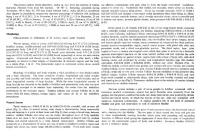
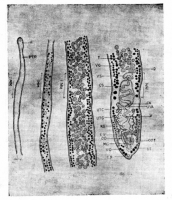
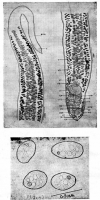


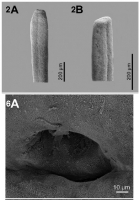

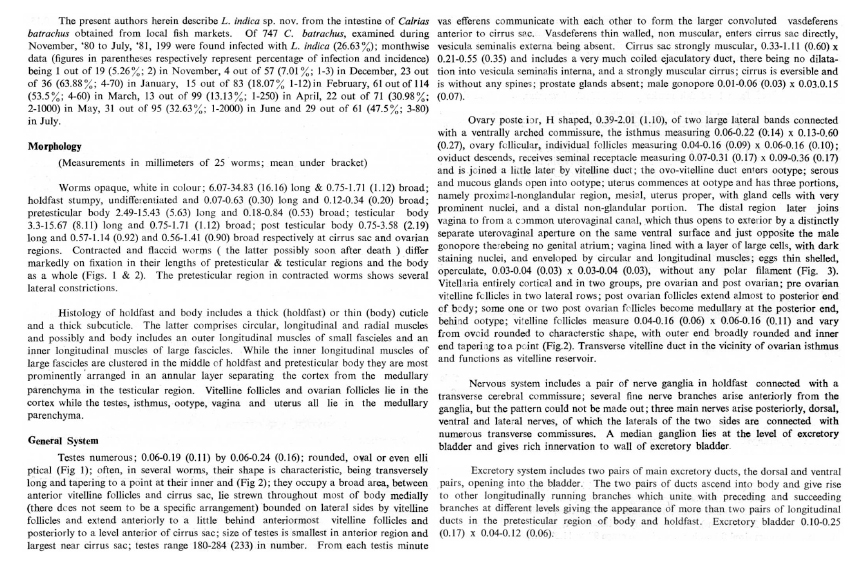
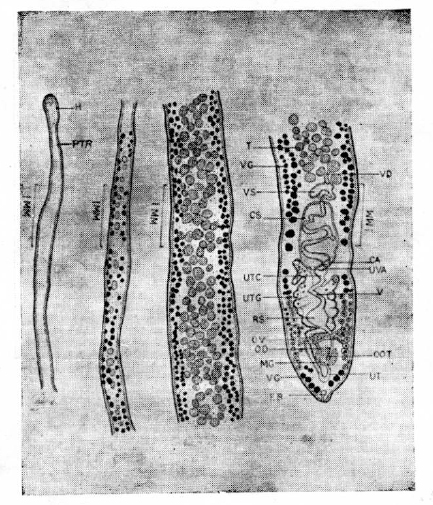 Fig. 1. Lucknowia indica W.M. with very long pretesticular region of body, rounded testes & vitelline follicles. Abbreviations: CA-Cirrus aperture; CS-Cirrus sac; E-Eggs; EB-Excretory bladder; ISTH-Isthmus; H-Hold fast, MG-Mehlis glands; MVG-Medullary vitelline gland; OD-oviduct; OV-ovary; OOT-ootype; RS-Receptaculum seminis; T-Testes; UT-uterus; UTC-Uterine canal; UTG-Glandular portion of uterus; UVA-Utero-vaginal aperture; V - Vagina; VG - Vitelline glands; VD - vas-dererences; VS - vesicula seminalis;
 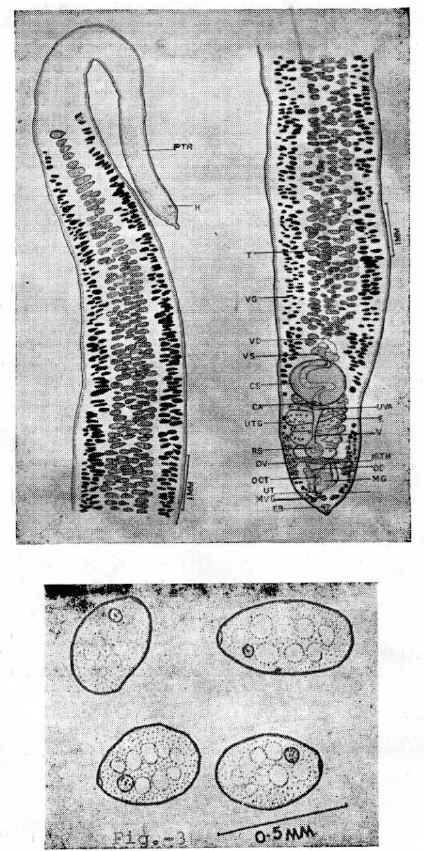 Fig. 2. Lucknowia indica W.M. with testes and vitellaria characteristic. Fig. 3. Eggs- operculate and without polar filament. Abbreviations: CA-Cirrus aperture; CS-Cirrus sac; E-Eggs; EB-Excretory bladder; ISTH-Isthmus; H-Hold fast, MG-Mehlis glands; MVG-Medullary vitelline gland; OD-oviduct; OV-ovary; OOT-ootype; RS-Receptaculum seminis; T-Testes; UT-uterus; UTC-Uterine canal; UTG-Glandular portion of uterus; UVA-Utero-vaginal aperture; V - Vagina; VG - Vitelline glands; VD - vas-dererences; VS - vesicula seminalis;
  FIGURE 3. Bovienia indica (Niyogi, Gupta and Agarwal, 1982) (A, C) Anterior part of the body with the first vitelline follicles and testes. (B) Scolex. (D) Posterior part of the body, ventral view; note the posterior extent of vitelline follicles and a common genital atrium (cga). (E) Total view of a
contracted specimen fixed with cold formalin, ventrally; *only the anteriormost and posteriormost testes illustrated. (F) Region with the anteriormost testes and vitelline follicles; note anastomosed excretory canals. (G, H) Posterior part of the body, ventral view; note slightly different posterior extent of vitelline follicles in relation to the cirrus-sac. (I) Cross-section at the level of the testicular region; note 2 layers of longitudinal muscles. (J) Region of gonopores, lateral view; note the presence of a muscular sphincter (sp) surrounding the uterovaginal canal and a common genital atrium. Abbreviations: cga = common genital atrium; cs = cirrus-sac; eb = excretory bladder; ec = excretory canal; elm = external longitudinal musculature; fgp = female genital pore; ilm = inner longitudinal musculature; Mg = Mehlis gland; mgp = male genital pore; ov = ovary; sd = sperm duct; sp = sphincter; sr = seminal receptacle; t = testis; va = vagina; vd = vitelloduct; vf = vitelline follicle; ug = uterine glands; ut = uterus.
FIGURE 3. Bovienia indica (Niyogi, Gupta and Agarwal, 1982) (A, C) Anterior part of the body with the first vitelline follicles and testes. (B) Scolex. (D) Posterior part of the body, ventral view; note the posterior extent of vitelline follicles and a common genital atrium (cga). (E) Total view of a
contracted specimen fixed with cold formalin, ventrally; *only the anteriormost and posteriormost testes illustrated. (F) Region with the anteriormost testes and vitelline follicles; note anastomosed excretory canals. (G, H) Posterior part of the body, ventral view; note slightly different posterior extent of vitelline follicles in relation to the cirrus-sac. (I) Cross-section at the level of the testicular region; note 2 layers of longitudinal muscles. (J) Region of gonopores, lateral view; note the presence of a muscular sphincter (sp) surrounding the uterovaginal canal and a common genital atrium. Abbreviations: cga = common genital atrium; cs = cirrus-sac; eb = excretory bladder; ec = excretory canal; elm = external longitudinal musculature; fgp = female genital pore; ilm = inner longitudinal musculature; Mg = Mehlis gland; mgp = male genital pore; ov = ovary; sd = sperm duct; sp = sphincter; sr = seminal receptacle; t = testis; va = vagina; vd = vitelloduct; vf = vitelline follicle; ug = uterine glands; ut = uterus.  Figure 1. Outlines of adults of caryophyllidean tapeworms (Cestoda) parasitizing Clarias batrachus in the Indomalayan Region. (A) Bovienia indica (Niyogi, Gupta and Agarwal, 1982). Abbreviations: cga = common genital atrium; fvf = first vitelline follicle; ft = first testis.
 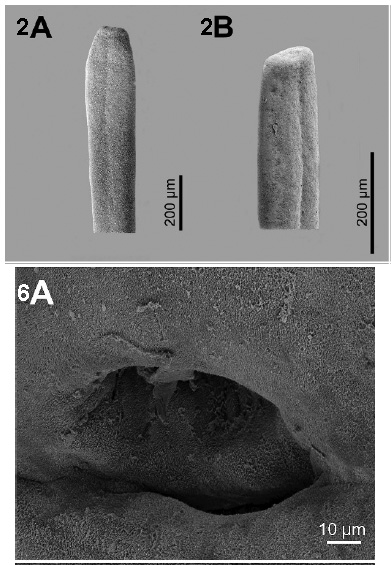 Figure 2. Scanning electron micrographs of the scolices of caryophyllidean tapeworms (Cestoda) from Clarias batrachus in the Indomalayan Region. (A,B) Bovienia indica (Niyogi, Gupta and Agarwal, 1982). Figure 6A. Genital pores. (A) Bovienia indica (Niyogi, Gupta and Agarwal, 1982); note presence of common genital atrium.
Best viewed in Firefox