Global Cestode Database
Cestode Scientific Name
| Species ID | 7229 |
|---|---|
| Order | Diphyllobothriidea |
| Family | Diphyllobothriidae |
| Subfamily | |
| Genus | Baylisiella |
| Species | tecta |
| Authority | (Linstow, 1892) Markowski, 1952 |
| Taxonomic Status | Valid |
| Valid Name | |
| Synonyms | Bothriocephalus tectus Linstow, 1892; Dibothriocephalus tectus (Linstow, 1892) Zschokke, 1903; Diphyllobothrium tectum (Linstow, 1892) Meggitt, 1924; Cordicephalus tectus (Linstow, 1892) Wardle, McLeod, & Stewart, 1947 |
| Genus Record | No |
| Type Species | Yes |
| Verified | No |
| Verified By | |
| Citation(s) |
von Linstow, O. 1892. Helminthen von Süd-Georgien. Jahrbuch der Hamburgischen Anstalten 9: 59-77. (6870) Download PDFMarkowski, S. 1952. The cestodes of seals from the Antarctic. Bulletin of the British Museum (Natural History) 1(7): 123-150. (6681) Download PDF |
| Redescription | |
| Scientific Name Notes |
Record Data
| Date (MM/DD/YYYY) | Action | User Name |
|---|---|---|
| 07/08/2010 | Created | B. Barbeau |
| 02/07/2013 | Modified | |
| 01/29/2016 | Modified | K. Mojica |
| 09/16/2016 | Modified | B. Barbeau |
| 08/08/2017 | Modified | R. Kuchta |
| 08/04/2023 | Modified | R. Kuchta |
Type Host
| Host Class | Mammalia | ||||||
|---|---|---|---|---|---|---|---|
| Host Order | Carnivora | ||||||
| Host Family | Phocidae | ||||||
|
Type Host (Literal) |
|
||||||
|
Type Host (Valid) |
|
||||||
| Additional Host(s) | |||||||
| Site in Host | |||||||
| Host Notes |
Type Locality
| Country | Antarctica |
|---|---|
| Body of Water | Southern Ocean |
| Island(s) | |
| City/Region | |
| Coordinates | |
| DD Latitude | |
| DD Longitude | |
| Additional Localities | |
| Locality Notes | -Markowski obtained from 2 elefant siels from Bay of Isles, South Georgia |
Specimens
| Type Material | |
|---|---|
| Total Number of Type Specimens | |
| Voucher Material | |
| Specimen Notes |
Data are given as in original description unless otherwise indicated.
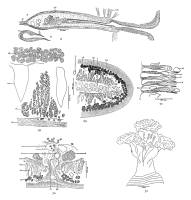
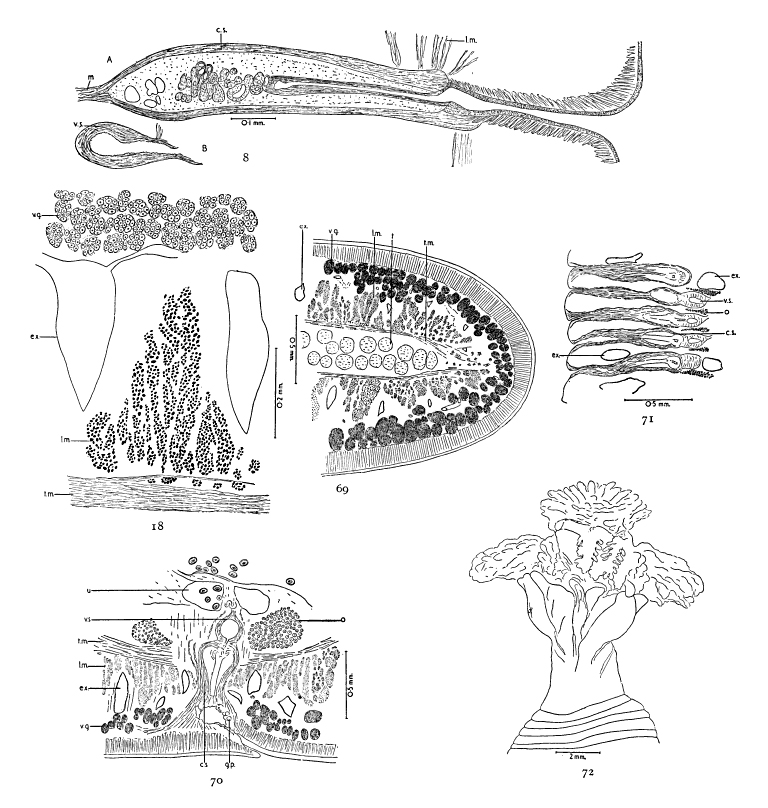 Baylisiella tecta from Elephant seal. Fig. 9. Sagittal section of cirrussac. Fig. 18. Transverse section of muscular system, showing its peculiar structure and the powerfully developed cortical excretory system. Only a part of cortical parenchyma and vitelline glands have been drawn. Fig. 69. Transverse section of segment. Fig. 70. Transverse section of male apparatus. Fig. 71. Sagittal section of segment. Fig. 72. Scolex.
 Best viewed in Firefox