Global Cestode Database
Cestode Scientific Name
| Species ID | 5812 |
|---|---|
| Order | Bothriocephalidea |
| Family | Bothriocephalidae |
| Subfamily | |
| Genus | Andycestus |
| Species | abyssmus |
| Authority | (Thomas, 1953) Kuchta, Scholz & Bray, 2008 |
| Taxonomic Status | Valid |
| Valid Name | |
| Synonyms | Bothriocephalus abyssmus Thomas, 1953 |
| Genus Record | No |
| Type Species | Yes |
| Verified | Yes |
| Verified By | R. Kuchta |
| Citation(s) |
Thomas, L. J. 1953. Bothriocephalus abyssmus n. sp., a tapeworm from the deep-sea fish, Echiostoma tanneri (Gill) with notes on its development. : 269-276. (4575) Download PDFKuchta, R., T. Scholz, and R. A. Bray. 2008. Revision of the order Bothriocephalidea Kuchta, Scholz, Brabec & Bray, 2008 (Eucestoda) with amended generic diagnoses and keys to families and genera. Systematic Parasitology 71: 81-136. (4553) Download PDF |
| Redescription | |
| Scientific Name Notes |
Record Data
| Date (MM/DD/YYYY) | Action | User Name |
|---|---|---|
| 03/03/2010 | Created | B. Barbeau |
| 06/24/2014 | Modified | |
| 07/12/2021 | Modified | R. Kuchta |
Type Host
| Host Class | Actinopterygii | ||||||
|---|---|---|---|---|---|---|---|
| Host Order | Stomiiformes | ||||||
| Host Family | Stomiidae | ||||||
|
Type Host (Literal) |
|
||||||
|
Type Host (Valid) |
|
||||||
| Additional Host(s) | |||||||
| Site in Host | illium | ||||||
| Host Notes |
Type Locality
| Country | Bermuda |
|---|---|
| Body of Water | Atlantic Ocean |
| Island(s) | |
| City/Region | |
| Coordinates | |
| DD Latitude | |
| DD Longitude | |
| Additional Localities | |
| Locality Notes | 20 miles south east of Bermuda, Atlantic Ocean |
Specimens
| Type Material | U.S. Nat. Museum Helm. Coll. No. 48746 |
|---|---|
| Total Number of Type Specimens | |
| Voucher Material | |
| Specimen Notes |
Data are given as in original description unless otherwise indicated.
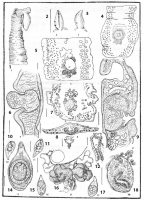
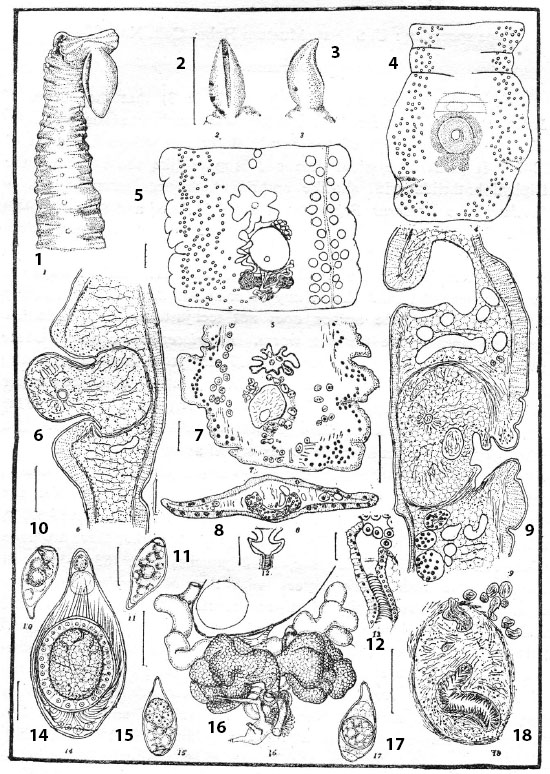 Fig. 1. Freehand drawing of scolex and anterior segments.
Figs. 2. and 3. Ventral and lateral views of the scolex.
Fig. 4. Dorsal view of immature segment showing hermaphroditic pore.
Fig. 5. Dorsal view of mature segment showing distribution of vitellaria, and at a lower level testes along nerve cord, uterine sac and tube, cirrus sac and vas deferens, vagina, ovarian lobes and genital complex.
Fig. 6. Transverse section through everted cirrus.
Fig. 7. Sagittal section of a segment showing vitellaria, testes, uterine sac, eggs, vas deferens, cirrus sac and vaginal pore.
Fig. 8. Transverse section showing ovarian isthmus, testes in medullary layer, and vitellaria in cortical layer.
Fig, 9. Longitudinal section showing hermaphroditic developmental stages.
Figs. 10, 11, 15, and 17. Eggs showing progressive developmental stages.
Fig. 12. Vaginal pore and duct with sphincter muscles.
Fig. 13. Oocapt showing sphincter muscles.
Fig. 14. Fully developed coracidium about to hatch.
Fig. 16. Reconstruction from sections; ventral views of the genital complex showing ovarian lobes, oviduct, vitelline ducts, Mehlis' gland, uterine tube and vagina.
Fig. 18. Transverse section through cirrus sac and inverted cirrus showing juncture with vas deferens and spines of cirrus.
Fig. 1. Freehand drawing of scolex and anterior segments.
Figs. 2. and 3. Ventral and lateral views of the scolex.
Fig. 4. Dorsal view of immature segment showing hermaphroditic pore.
Fig. 5. Dorsal view of mature segment showing distribution of vitellaria, and at a lower level testes along nerve cord, uterine sac and tube, cirrus sac and vas deferens, vagina, ovarian lobes and genital complex.
Fig. 6. Transverse section through everted cirrus.
Fig. 7. Sagittal section of a segment showing vitellaria, testes, uterine sac, eggs, vas deferens, cirrus sac and vaginal pore.
Fig. 8. Transverse section showing ovarian isthmus, testes in medullary layer, and vitellaria in cortical layer.
Fig, 9. Longitudinal section showing hermaphroditic developmental stages.
Figs. 10, 11, 15, and 17. Eggs showing progressive developmental stages.
Fig. 12. Vaginal pore and duct with sphincter muscles.
Fig. 13. Oocapt showing sphincter muscles.
Fig. 14. Fully developed coracidium about to hatch.
Fig. 16. Reconstruction from sections; ventral views of the genital complex showing ovarian lobes, oviduct, vitelline ducts, Mehlis' gland, uterine tube and vagina.
Fig. 18. Transverse section through cirrus sac and inverted cirrus showing juncture with vas deferens and spines of cirrus. 
Best viewed in Firefox