Global Cestode Database
Cestode Scientific Name
| Species ID | 5640 |
|---|---|
| Order | Lecanicephalidea |
| Family | Polypocephalidae |
| Subfamily | |
| Genus | Polypocephalus |
| Species | visakhapatnamensis |
| Authority | Vankara, Vijaya Lakshmi & Vijaya Lakshmi, 2007 |
| Taxonomic Status | Species inquirenda |
| Valid Name | |
| Synonyms | |
| Genus Record | No |
| Type Species | No |
| Verified | No |
| Verified By | |
| Citation(s) |
Vankara, A. P., C. Vijaya Lakshmi, and J. Vijaya Lakshmi. 2007. Polypocephalus viskhapatnamensis sp. nov. (Lecanicephalidea: Polypocephalidae) from Himantura uarnak (Forsskål) and Dasyatis (Amphotistius) zugei (Müller & Henle) from Visakhapatnam coast. Journal of Parasitic Diseases 31(2): 152-154. (4487) Download PDF |
| Redescription | |
| Scientific Name Notes | This species is considered to be a species inquirenda because the description is based on a mix of specimens from two host species (i.e., Himantura uarnak and Dasyatis zugei) and because of a lack of access to the type specimens at the specified collection in India. |
Record Data
| Date (MM/DD/YYYY) | Action | User Name |
|---|---|---|
| 09/10/2009 | Created | K. Koch |
| 01/03/2013 | Modified | |
| 01/09/2016 | Modified | K. Jensen |
| 01/12/2016 | Modified | K. Mojica |
| 01/21/2016 | Modified | K. Mojica |
| 01/29/2016 | Modified | K. Jensen |
| 08/20/2016 | Modified | K. Jensen |
Type Host
| Host Class | |||||||
|---|---|---|---|---|---|---|---|
| Host Order | Myliobatiformes | ||||||
| Host Family | Dasyatidae | ||||||
|
Type Host (Literal) |
|
||||||
|
Type Host (Valid) |
|
||||||
| Additional Host(s) | Dasyatis (Amphotistius) zugei | ||||||
| Site in Host | spiral intestine | ||||||
| Host Notes |
Type Locality
| Country | India |
|---|---|
| Body of Water | Bay of Bengal |
| Island(s) | |
| City/Region | Andhra Pradesh |
| Coordinates | |
| DD Latitude | |
| DD Longitude | |
| Additional Localities | |
| Locality Notes |
Specimens
| Type Material | Holotype and Paratypes deposited in the Parasitology Laboratory, Department of Zoology, Andhra University, Visakhapatnam, India |
|---|---|
| Total Number of Type Specimens | 8 |
| Voucher Material | |
| Specimen Notes | apparently 16 specimens were collected but only 8 were used to generate the quantitative data |
Data are given as in original description unless otherwise indicated.
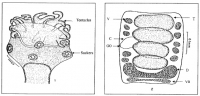
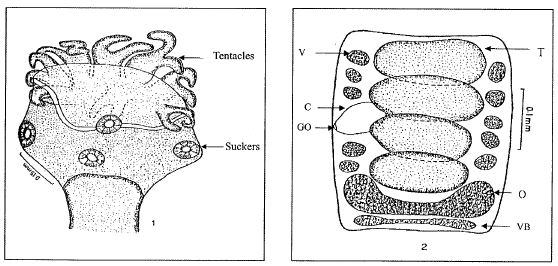 Fig. 1. Scolex showing bifucated tentacles and four suckers
Fig. 2. Mature proglottid., T-testes, O-Ovary, V-Vitellaria, C-Cirrus sac, VB-Vitelline band and GO-Gential opening
Fig. 1. Scolex showing bifucated tentacles and four suckers
Fig. 2. Mature proglottid., T-testes, O-Ovary, V-Vitellaria, C-Cirrus sac, VB-Vitelline band and GO-Gential opening Best viewed in Firefox