Global Cestode Database
Cestode Scientific Name
| Species ID | 4781 |
|---|---|
| Order | Trypanorhyncha |
| Family | Lacistorhynchidae |
| Subfamily | |
| Genus | Pseudogilquinia |
| Species | karachiensis |
| Authority | Bilqees & Khatoon, 1980 |
| Taxonomic Status | Valid |
| Valid Name | |
| Synonyms | |
| Genus Record | No |
| Type Species | Yes |
| Verified | Yes |
| Verified By | I. Beveridge |
| Citation(s) |
Bilquees, F. M. and A. Khatoon. 1980. A new trypanorhynchid family Pseudogilquiniidae including a new genus and species Pseudogilquinia karachiense. Philippine Journal of Science 109(3-4): 89-92. (5597) Download PDF |
| Redescription | |
| Scientific Name Notes | Orthography of specific name corrected by Palm (2004). This species was previously listed as a "species inquirenda" but has been changed to "valid name" here to reflect its inclusion in the PBI 2017 special issue's valid species list |
Record Data
| Date (MM/DD/YYYY) | Action | User Name |
|---|---|---|
| 11/30/-0001 | Created | I. Beveridge |
| 06/26/2012 | Modified | |
| 05/25/2015 | Modified | I. Beveridge |
| 07/28/2017 | Modified | K. Herzog |
Type Host
| Host Class | Actinopterygii | ||||||
|---|---|---|---|---|---|---|---|
| Host Order | Perciformes | ||||||
| Host Family | Haemulidae | ||||||
|
Type Host (Literal) |
|
||||||
|
Type Host (Valid) |
|
||||||
| Additional Host(s) | |||||||
| Site in Host | mesentery | ||||||
| Host Notes | from "visceral mesenteries (on stomach)" |
Type Locality
| Country | Pakistan |
|---|---|
| Body of Water | Indian Ocean |
| Island(s) | |
| City/Region | fish market, Karachi |
| Coordinates | |
| DD Latitude | |
| DD Longitude | |
| Additional Localities | |
| Locality Notes |
Specimens
| Type Material | DZUK no. SPUK 1926-1927 (types) |
|---|---|
| Total Number of Type Specimens | |
| Voucher Material | |
| Specimen Notes |
Data are given as in original description unless otherwise indicated.
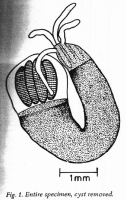
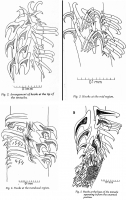
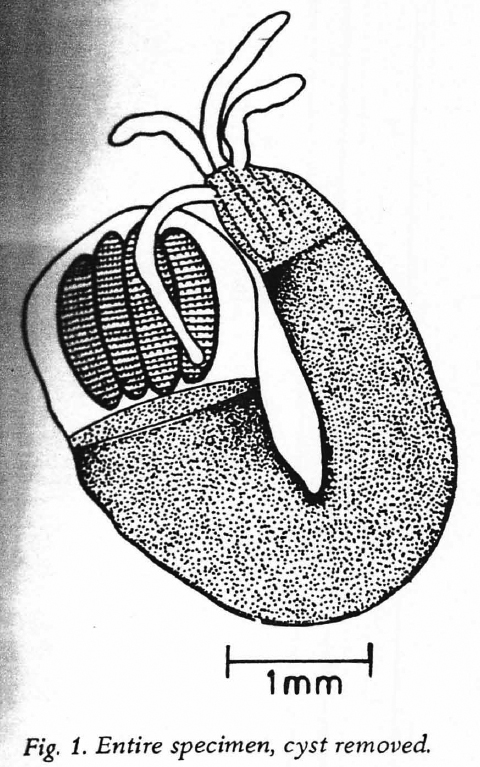 Fig. 1. Entire specimen, cyst removed
  Fig. 2. Arrangement of hooks at the tip of the tentacles. Fig. 3. Hooks at the mid region. Fig. 4. Hooks at the metabasal region. Fig. 5. Hooks at the base of the tentacle separating it from the unarmed portion.
 Best viewed in Firefox