Global Cestode Database
Cestode Scientific Name
| Species ID | 4689 |
|---|---|
| Order | Trypanorhyncha |
| Family | Eutetrarhynchidae |
| Subfamily | |
| Genus | Trimacracanthus |
| Species | binuncus |
| Authority | (Linton, 1908) Beveridge & Campbell, 1987 |
| Taxonomic Status | Valid |
| Valid Name | |
| Synonyms | Rhynchobothrium binuncum Linton, 1908; Tentacularia binunca (Linton, 1908) Southwell, 1929 |
| Genus Record | No |
| Type Species | No |
| Verified | Yes |
| Verified By | I. Beveridge |
| Citation(s) |
Linton, E. 1908. IX. Helminth fauna of the Dry Tortugas. I. Cestodes. Publication No. 102, Papers from the Tortugas Laboratory of the Carnegie Institution of Washington 1: 157-190. (277) Download PDFBeveridge, I. and R. A. Campbell. 1987. Trimacracanthus gen. nov. (Cestoda: Trypanorhyncha: Eutetrarhynchidae), with redescriptions of T. aetobatidis (Robinson, 1959) comb. nov. and T. binuncus (Linton, 1909) comb. nov.. Transactions of the Royal Society of South Australia 111(4): 163-171. (4426) Download PDF |
| Redescription | |
| Scientific Name Notes | Publication date variously cited as 1908 or 1909, but 1908 is the correct year for the publication. Southwell (1929), Dollfus (1942) and Beveridge & Campbell (1987), however, all use Linton (1909) rather than Linton (1908). |
Record Data
| Date (MM/DD/YYYY) | Action | User Name |
|---|---|---|
| 11/30/-0001 | Created | I. Beveridge |
| 08/16/2012 | Modified | |
| 06/04/2015 | Modified | I. Beveridge |
| 05/17/2016 | Modified | B. Barbeau |
| 05/30/2017 | Modified | K. Herzog |
| 08/23/2017 | Modified | K. Herzog |
| 08/30/2017 | Modified | K. Jensen |
| 07/08/2020 | Modified | B. Barbeau |
Type Host
| Host Class | Elasmobranchii | ||||||
|---|---|---|---|---|---|---|---|
| Host Order | Myliobatiformes | ||||||
| Host Family | Dasyatidae | ||||||
|
Type Host (Literal) |
|
||||||
|
Type Host (Valid) |
|
||||||
| Additional Host(s) | |||||||
| Site in Host | spiral intestine | ||||||
| Host Notes | Southwell (1929) also lists "Dasybatus sp. (walga? )" as a host for this species. |
Type Locality
| Country | U.S.A. |
|---|---|
| Body of Water | Atlantic Ocean |
| Island(s) | |
| City/Region | Dry Tortugas, Florida |
| Coordinates | |
| DD Latitude | |
| DD Longitude | |
| Additional Localities | |
| Locality Notes | Southwell (1929) also lists "Ceylon Pearl Banks" as a locality for this species. |
Specimens
| Type Material | USNPC 9010 (lectotypes & paralectotypes) (as reported in Beveridge and Campbell, 1987) |
|---|---|
| Total Number of Type Specimens | |
| Voucher Material | |
| Specimen Notes |
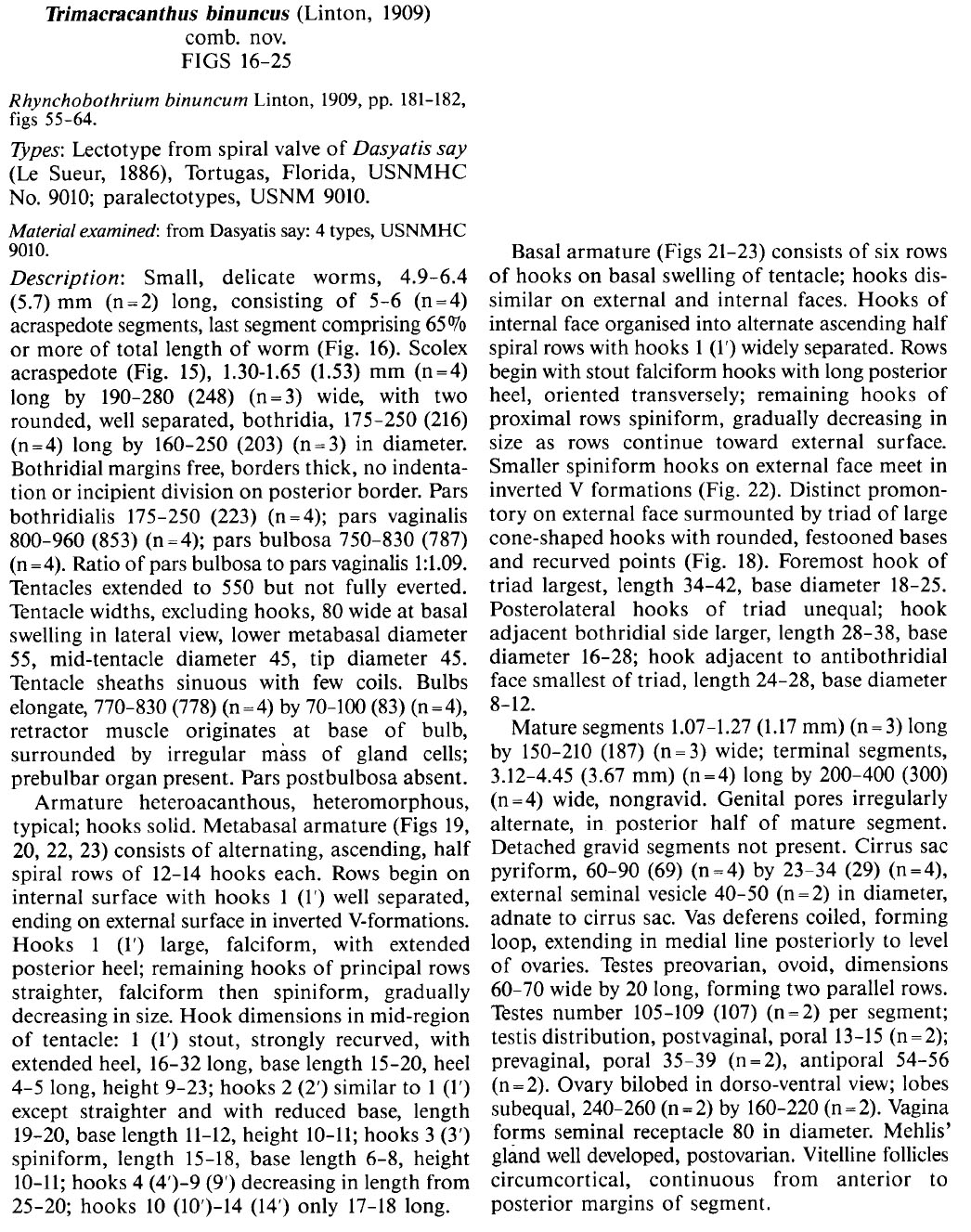
Data are given as in original description unless otherwise indicated.
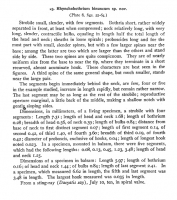
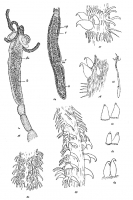
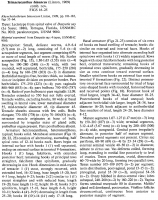
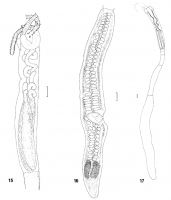
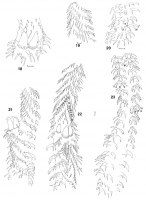
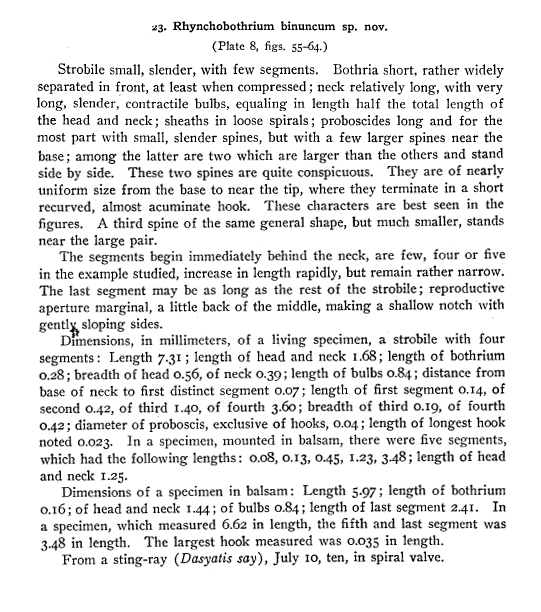
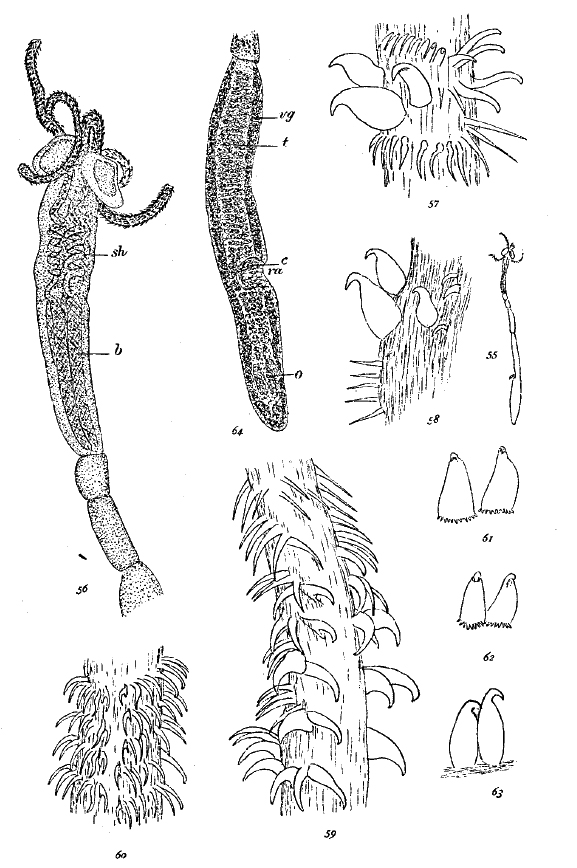 Plate 8. Rhynchobothrium binuncum sp. nov., from Dasyatis say. 55. Strobile, balsam; actual length 5 mm. 56. Head, neck, and anterior end of the body, balsam; length of head and neck 1.25 mm. 57, 58. Different views of base of proboscis, showing characteristic paired hooks; length of largest hooks 0.03 mm. 59. Another view of proboscis; diameter, exclusive of hooks, 0.03 mm. 60. View of proboscis towards distal end; diameter, exclusive of hooks, 0.035 mm. 61, 62, 63. Different views of paired hooks which are situated near the base of each proboscis. The pairs shown in these sketches are from different proboscides; length of longest 0.030, 0.031, and 0.035 mm. in the several pairs. 64. Posterior segment, specimen mounted in balsam; actual length 2.41 mm. Length of strobile from which this sketch was made 5.97 mm. Abbreviations: b. Muscular bulbs, whose use is to evert the proboscides by pressure on fluid with which they are filled; c. Cirrus; o. Ovary; r. a. Reproductive aperture; sh. Proboscis sheath; t. Testes; v. g. Vitelline glands.
  Beveridge and Campbell (1987), pg. 167
 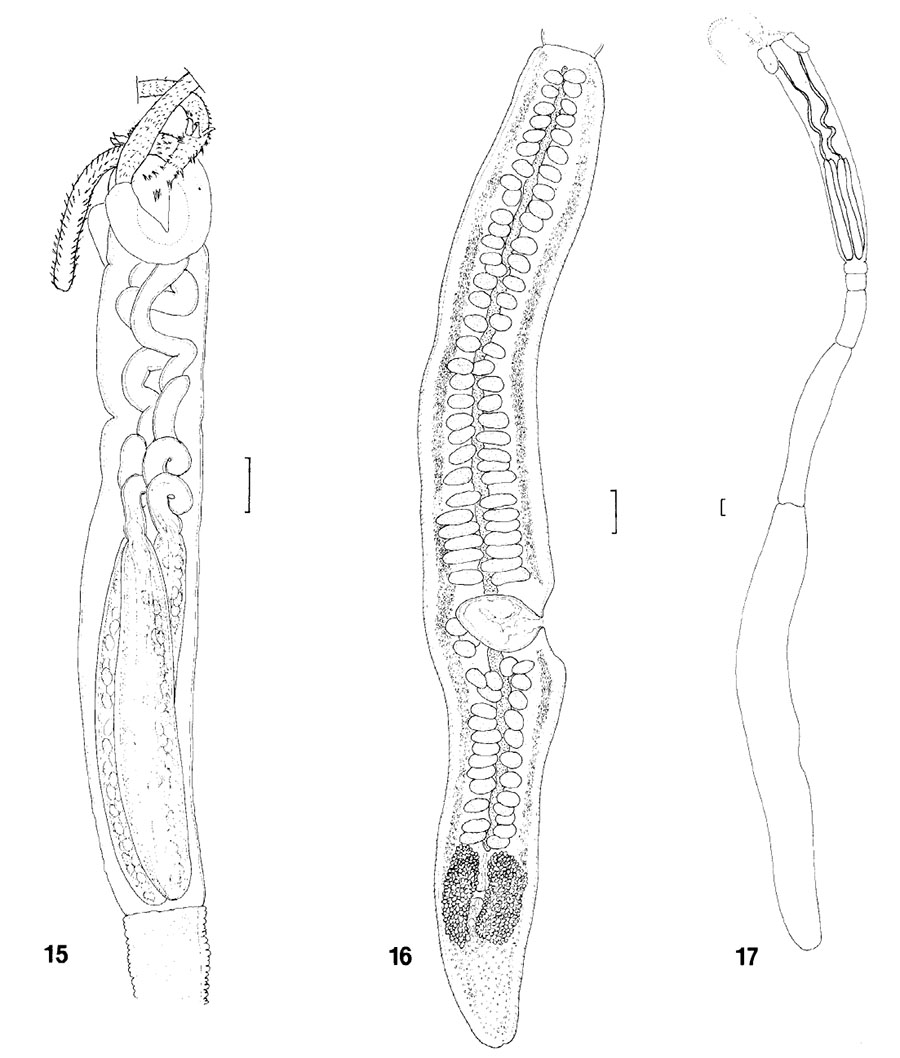 Figs 15-17. Trimacracanthus binuncus (Linton). 15, scolex; 16, terminal segment; 17, entire worm. Scale lines: fig. 17, 1.0 mm; figs 15-16, 0.1 mm.
 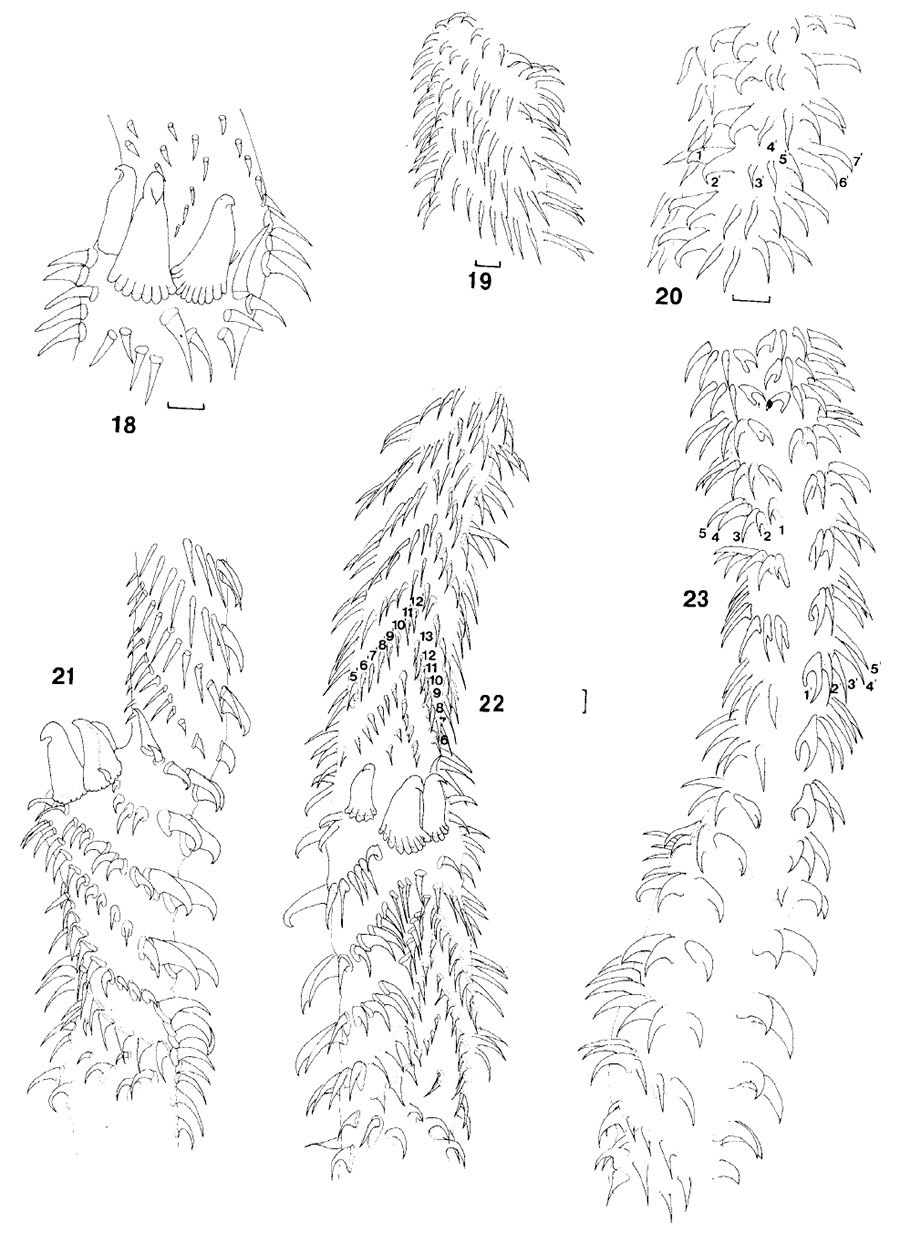 Figs 18-23. Trimacracanthus binuncus (Linton). 18, triad of enlarged hooks on external surface of basal swelling; 19, metabasal region, antibothridial surface; 20, metabasal region, internal surface to left; 21, basal armature, bothridial surface; 22, basal and metabasal armature, external surface; 23, basal and metabasal armature, internal surface; note long guards on hooks 1 (1') of metabasal region. Scale line: 0.1 mm.
 Best viewed in Firefox