Global Cestode Database
Cestode Scientific Name
| Species ID | 4685 |
|---|---|
| Order | Trypanorhyncha |
| Family | Eutetrarhynchidae |
| Subfamily | |
| Genus | Tetrarhynchobothrium |
| Species | unionifactor |
| Authority | (Shipley & Hornell, 1904) Beveridge & Campbell, 1988 |
| Taxonomic Status | Valid |
| Valid Name | |
| Synonyms | Tetrarhynchus unionifactor Shipley & Hornell, 1904; Tentacularia unionifactor (Shipley & Hornell, 1904) Southwell, 1929 |
| Genus Record | No |
| Type Species | No |
| Verified | Yes |
| Verified By | I. Beveridge |
| Citation(s) |
Shipley, A. E. and J. Hornell. 1904. The parasites of the pearl oyster. Report to the Government of Ceylon on the Pearl Oyster Fisheries of the Gulf of Manaar (Herdman), Part II 11: 77-106. (429) Download PDFBeveridge, I. and R. A. Campbell. 1988. A review of the Tetrarhynchobothriidae Dollfus, 1969 (Cestoda: Trypanorhyncha) with descriptions of two new genera, Didymorhynchus and Zygorhynchus. Systematic Parasitology 12: 29-Mar. (4283) Download PDF |
| Redescription | |
| Scientific Name Notes | This species has a complicated taxonomic history. The name "Tetrarhynchus unionifactor" first appears in the literature in a letter to the editor wirtten by W.A. Herdman and published in the 1903 volume of Nature (citation #7036). Here, Herdman transcribes part of a letter he received from J. Hornell: "Just a line to tell you that I have found the final host of Tetrarhynchus unionifactor ". In a footnote, Herman clarifies that Tetrarhynchus unionifactor is "the name we gave to this Tetrarhynchus larva in our notes and letters until it was ascertained whether the species is known or new". Herdman concludes the letter to the editor by saying "Mr. Arthur Shipley, who is writing a joint paper with Mr. Hornell...will no doubt discuss the matter fully later on...". In a 1903 report on the proceedings of the British Association for the Advancement of Science, a summary of a paper read on pearl formation in Ceylon by Herdman and Hornell is given, which states "The parasite in the case of the majority of the cyst-pearls of Ceylon is the larva of a Cestode which appears to be new, and will be described under the name Tetrarhynchus unionifactor". Then, in 1904, Shipley and Hornell formally describe Tetrarhynchus unionifactor as larve from the pearl oyster (citation #429). Even though this 1904 description is not the first usage of the name in the literature, it is the first time the species is formally described, and thus Shipley & Hornell (1904) should be considered the authority of the name "Tetrarhynchus unionifactor". In 1906, Shipley & Hornell (citation #431) recovered adults of what they consider to also be Tetrarhynchus unionifactor from the stomach and intestines of Rhinoptera javanica, and therein ammend their original description of Tetrarhynchus unionifactor to include the features of the adult worms. In 1929, Southwell (citation #446) creates the new combination "Tentacularia unionifactor" and lists as a synonym "Tetrarhynchus unionifactor Shipley & Hornell, 1904". He cites the ammended description from Shipley & Hornell (1906), and concludes by saying "It is not possible to identify the parasite from the above description...It is almost certain that the larval forms named T. unionfactor, Shipley and Hornell, 1904, from Margaritifera vulgaris belong to the genus Tylocephalum, Linton, 1890.". Thus, it appears that Southwell (1929) considered the adults from Rhioptera javanica to belong to the trypanorhynch genus Tentacularia, and the larvae from Margaritifera vulgaris to be a separate species belonging to the lecanicephalidean genus to Tylocephalum. This may be the first usage of the combination "Tylocephalum unionifactor". In his keys to cestodes, Schmidt (1986) (citation #660) considers Tylocephalum unionifactor to belong to the genus Lecanicephalum, creating the new combination "Lecanicephlaum unionifactor". He cites the authority for the name "Tylocephalum unionifactor" as "Herdmann et Hornell 1903"; however, this publication does not exist. Schmidt may have been refering to the publication "Pearl Production" by Herdman & Hornell (1904) (included in citation #556), a 42-page report which mentions Tetrarhynchus unionifactor, or may have been referring to one of the two earlier usages of the name in the literature from 1903 mentioned above. In their rededscription of the species in 1988, Beveridge & Campbell (citation #4283) move the species to the genus Tetrarhynchobothrium and also express doubt that the larve from the pearl oyster and the adults from R. javanica are conspecific: "...the type (larval) specimen cannot therefore be identified, with absolute certainty, with any of the species whose segment anatomy is known. Whether Shipley & Hornell's (1906) specimens from R. javanica belong to T. unionifactor or not cannot at present be decided from the types, although Pintner (1931a) decided that they do not. The adults do appear to represent a distinct species, and it seems reasonable to utilise the name unionifactor for them until further detailed studies can be made on new material from the type-locality.". |
Record Data
| Date (MM/DD/YYYY) | Action | User Name |
|---|---|---|
| 11/30/-0001 | Created | I. Beveridge |
| 06/03/2014 | Modified | |
| 06/08/2015 | Modified | I. Beveridge |
| 08/23/2017 | Modified | K. Herzog |
| 08/24/2017 | Modified | K. Herzog |
| 04/06/2018 | Modified | K. Herzog |
| 12/22/2021 | Modified | B. Barbeau |
Type Host
| Host Class | Bivalvia | ||||||
|---|---|---|---|---|---|---|---|
| Host Order | Ostreida | ||||||
| Host Family | Pteriidae | ||||||
|
Type Host (Literal) |
|
||||||
|
Type Host (Valid) |
|
||||||
| Additional Host(s) | |||||||
| Site in Host | tissues | ||||||
| Host Notes | Shipley & Hornell (1906) later report this species from the stomach and spiral intestine of Rhinoptera javanica, but Beveridge & Campbell (1988) expressed doubts as to whether the cestodes from these two different hosts were the same species. |
Type Locality
| Country | Ceylon [Sri Lanka] |
|---|---|
| Body of Water | Gulf of Mannar |
| Island(s) | |
| City/Region | |
| Coordinates | |
| DD Latitude | |
| DD Longitude | |
| Additional Localities | |
| Locality Notes |
Specimens
| Type Material | NMW 60 (“co-type” from Pinctada imbricata) |
|---|---|
| Total Number of Type Specimens | |
| Voucher Material | NMW 3330 (vouchers from Rhinoptera javanica) |
| Specimen Notes |
Data are given as in original description unless otherwise indicated.
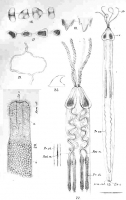
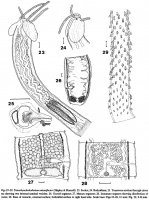

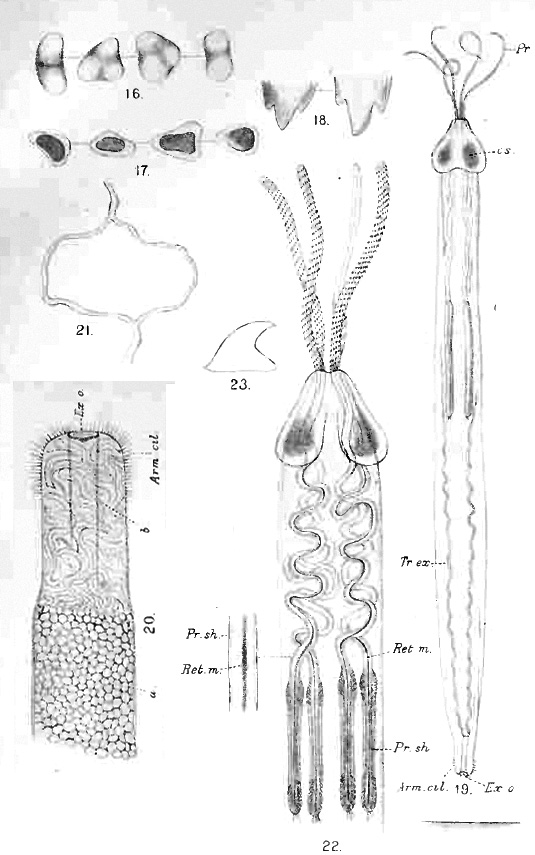 Fig. 16. Forms of the calcereous corpuscles found in the larvae of Tetrarhynchus unionifactor. Fig. 17. The same, enclosed in the cells that secrete them. Fig. 18. Form of denticles which ornament the proboscis collar of the early larva of Tetrarhynchus unionifactor. Fig. 19. The oldest larval stage of Tetrarhynchus unionifactor met with in the tissues of the pearl oyster. Arm. cil., armature of stiff cilia around excretory pore; cs. one of the two pairs of cephalic suckers; Ex.o., external orifice of excretory system; Pr., protractile proboscides; Tr.ex., lateral trunks of excretory system. Fig. 20. Surface view of the posterior extremity of the same individual on an enlarged scale. a. Shows the warted pattern of the whole surface of the body, except at the extreme posterior extremity, where, as shown (b), the surface marking becomes sinuous; other letters as in fig. 19. Fig. 21. A loop of the excretory network in the cephalic region of the same individual. Fig. 22. Anterior extremity of an individual of the same stage as that depicted in fig. 19 seen under greater magnification. Pr.sh., sheath of proboscis; Ret.m., retractor muscle of proboscis. Fig. 23. One of the hooklets from a proboscis.
 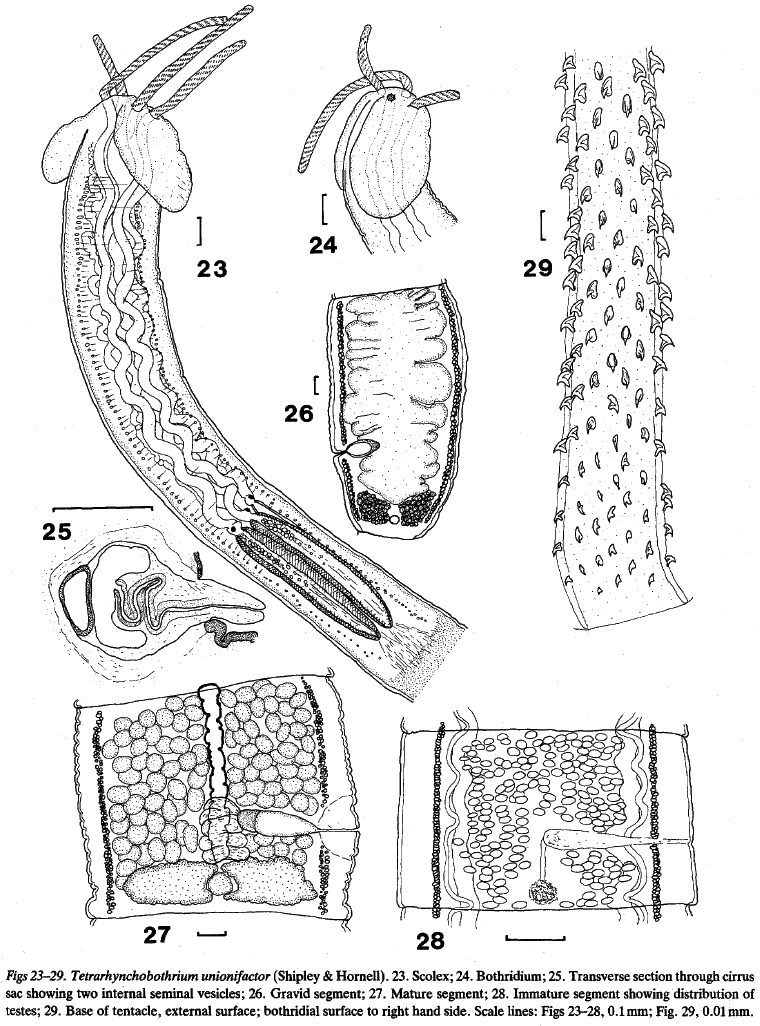 From Beveridge & Campbell, 1988 (Cit# 4283). Figs2 3-29. Tetrarhynchobothrium unionifactor ( Shipley & Hornell). 23. Scolex; 24. Bothridium; 25. Transverse section through cirrus sac showing two internal seminal vesicles; 26. Gravid segment; 27. Mature segment; 28. Immature segment showing distribution of testes; 29. Base of tentacle, external surface; bothridial surface to right hand side. Scale lines: Figs 23-28, 0.1 mm; Fig. 29, 0.01 mm.
  Beveridge and Campbell (1988), pg. 14
 Best viewed in Firefox