Global Cestode Database
Cestode Scientific Name
| Species ID | 3745 |
|---|---|
| Order | Spathebothriidea |
| Family | Spathebothriidae |
| Subfamily | |
| Genus | Spathebothrium |
| Species | simplex |
| Authority | Linton, 1922 |
| Taxonomic Status | Valid |
| Valid Name | |
| Synonyms | |
| Genus Record | No |
| Type Species | Yes |
| Verified | Yes |
| Verified By | T. Scholz |
| Citation(s) |
Linton, E. 1922. A new cestode from Liparis liparis. Transactions of the American Microscopical Society 41(3): 118-121 . (6148) Download PDF |
| Redescription |
Kuchta, R.,R. Pearson, T. Scholz, O. Ditrich, and P. D. Olson. 2014. Spathebothriidea: survey of species, scolex and egg morphology, and interrelationships of a non-segmented, relictual tapeworm group (Platyhelminthes: Cestoda). Folia Parasitologica 61(4): 331–346. (6420) Download PDF |
| Scientific Name Notes | Kuchta et al. (2014) reviewed the whole order, assessed the phylogenetic relationships of all genera and provided a survey of all valid species with new data on egg and scolex morphology and surface ultrastructure (i.e. microtriches). |
Record Data
| Date (MM/DD/YYYY) | Action | User Name |
|---|---|---|
| 11/30/-0001 | Created | K. Catanese |
| 08/20/2014 | Modified | |
| 02/02/2016 | Modified | K. Mojica |
| 05/17/2016 | Modified | B. Barbeau |
Type Host
| Host Class | |||||||
|---|---|---|---|---|---|---|---|
| Host Order | Scorpaeniformes | ||||||
| Host Family | Liparidae | ||||||
|
Type Host (Literal) |
|
||||||
|
Type Host (Valid) |
|
||||||
| Additional Host(s) | |||||||
| Site in Host | intestine | ||||||
| Host Notes |
Type Locality
| Country | U.S.A. |
|---|---|
| Body of Water | Atlantic Ocean |
| Island(s) | |
| City/Region | Woods Hole, Massachusetts |
| Coordinates | |
| DD Latitude | |
| DD Longitude | |
| Additional Localities | |
| Locality Notes |
Specimens
| Type Material | -USNPC No. 8855 (type) |
|---|---|
| Total Number of Type Specimens | |
| Voucher Material | |
| Specimen Notes |
Data are given as in original description unless otherwise indicated.
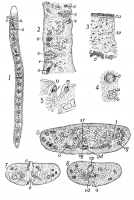
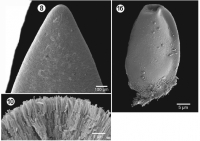
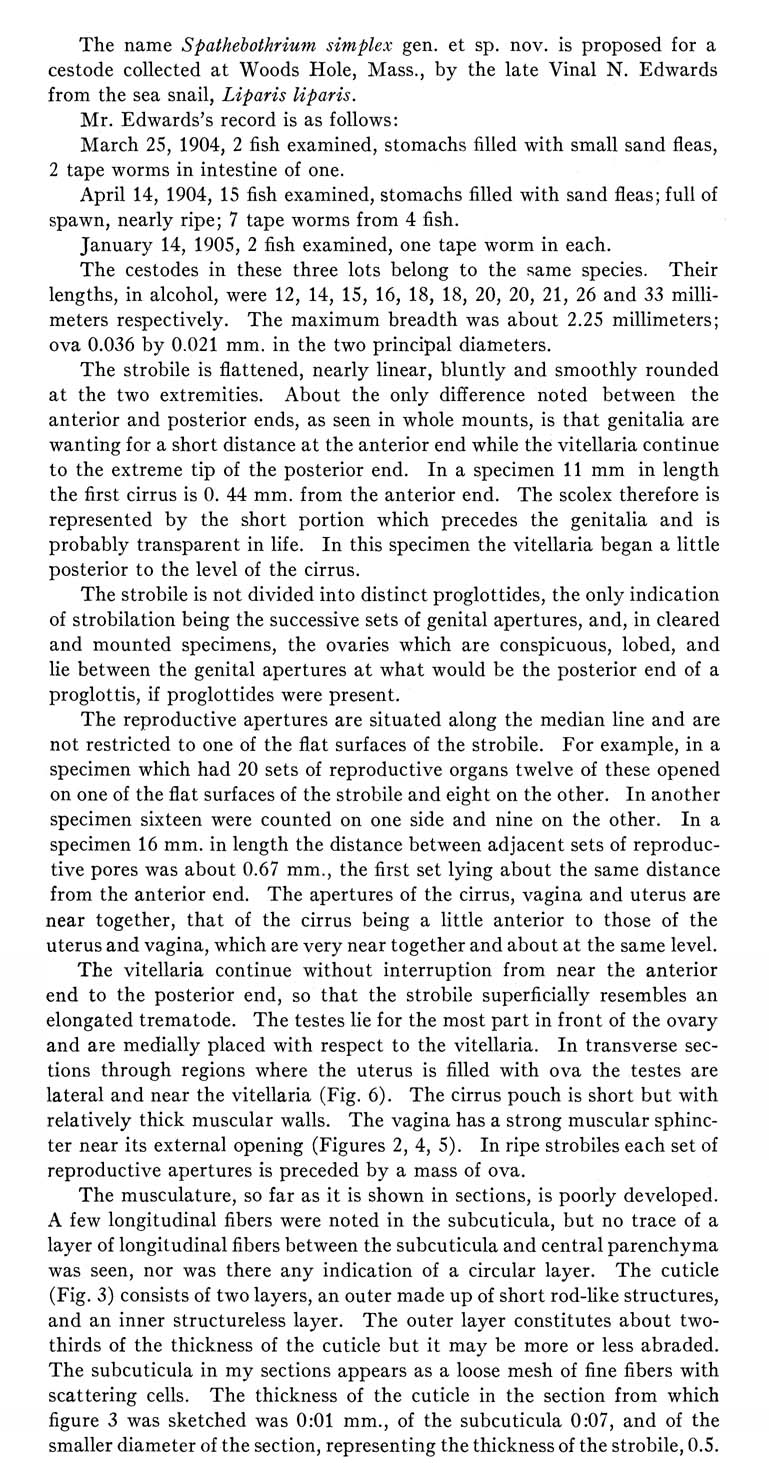
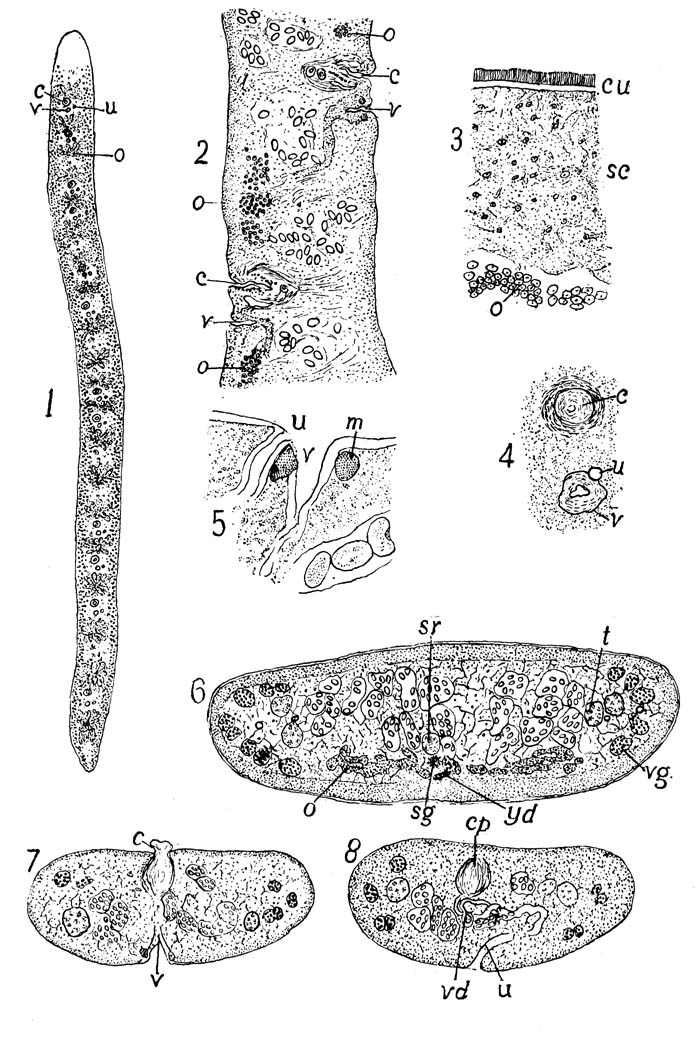 Fig. 1. Sketch of specimen mounted in balsam, somewhat diagrammatic. In this specimen there were 12 sets of reproductive apertures on one side and 8 on the other. Length 16 mm. Fig. 2. Sagittal section near median line showing reproductive apertures on opposite sides of the strobile. The succeeding section to this in the series shows the uterus in about the same relative position as that of the vagina in the lower left of the sketch. Thickness of strobile at this point 0.30 mm. Fig. 3. Cuticle and subcuticula highly magnified. Thickness of cuticle 0.01 mm. Fig. 4. Reproductive apertures as seen in horizontal section. Sketch made from section showing first appearance of the uterus. The vagina had appeared first in the preceding section, and the cirrus in the sixth preceding section. Diameter of cirrus bulb 0.24 mm. Fig. 5. External apertures of vagina and uterus, transverse section. Long diameter of ovum 0.035 mm. Fig. 6. Transverse section showing uterus with ova, etc. Breadth of strobile at this point. 1.5 mm. Fig. 7. Transverse section showing exceptional arrangement of genital pores, the cirrus opening on one side and the vagina on the other. Longer diameter of section 0.98 mm. Fig. 8. From same series of sections as Fig. 7, two sections intervening between 7 and 8. The cirrus bulb still shows and the vagina is replaced by the uterus.
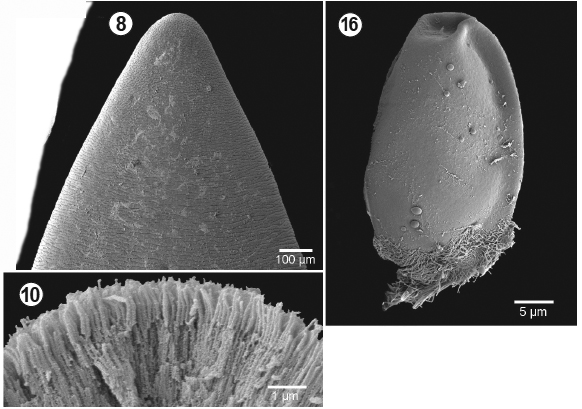 Figs. 1–10. Spathebothriidean cestodes; scanning electron micrographs.
Figs. 8, 10. Spathebothrium simplex from Liparis fabricii, Petunia Bay, Svalbard, Arctic Ocean. Scolex in apical
view (1, 2, 7) and dorsoventral (6, 8). Surface of the scolex covered with capilliform filitriches, magnification 10 000× (3–5, 9, 10).
Figs. 15–24. The eggs of spathebothriidean and amphilinidean cestodes; scanning electron micrographs and photomicrographs.
Fig. 16. Spathebothrium simplex
from Liparis fabricii, Petunia Bay, Svalbard, Arctic Ocean.
Figs. 1–10. Spathebothriidean cestodes; scanning electron micrographs.
Figs. 8, 10. Spathebothrium simplex from Liparis fabricii, Petunia Bay, Svalbard, Arctic Ocean. Scolex in apical
view (1, 2, 7) and dorsoventral (6, 8). Surface of the scolex covered with capilliform filitriches, magnification 10 000× (3–5, 9, 10).
Figs. 15–24. The eggs of spathebothriidean and amphilinidean cestodes; scanning electron micrographs and photomicrographs.
Fig. 16. Spathebothrium simplex
from Liparis fabricii, Petunia Bay, Svalbard, Arctic Ocean. Best viewed in Firefox