Global Cestode Database
Cestode Scientific Name
| Species ID | 3080 |
|---|---|
| Order | Phyllobothriidea |
| Family | Phyllobothriidae |
| Subfamily | |
| Genus | Crossobothrium |
| Species | laciniatum |
| Authority | Linton, 1889 |
| Taxonomic Status | Valid |
| Valid Name | |
| Synonyms | Phyllobothrium laciniatum (Linton, 1889) Yamguti, 1952 |
| Genus Record | No |
| Type Species | Yes |
| Verified | No |
| Verified By | |
| Citation(s) |
Linton, E. 1889. Notes on Entozoa of marine fishes of New England, with descriptions of several new species. United States Commision of Fish and Fisheries. Part XIV. Report of the Commissioner for 1886 14: 453-511. (266) Download PDF |
| Redescription | |
| Scientific Name Notes | Linton (1890, Cit# 1011) recognizes an unusual worm as Crossobothrium laciniatum "Variety longicollis" |
Record Data
| Date (MM/DD/YYYY) | Action | User Name |
|---|---|---|
| 09/09/2006 | Created | K. Jensen , R. Tracy |
| 02/12/2015 | Modified | |
| 06/06/2015 | Modified | T. Ruhnke |
| 05/10/2016 | Modified | B. Barbeau |
| 08/07/2017 | Modified | V. Bueno |
| 03/10/2020 | Modified | B. Barbeau |
| 11/14/2020 | Modified | J. Caira |
Type Host
| Host Class | elasmobranchii | ||||||
|---|---|---|---|---|---|---|---|
| Host Order | Lamniformes | ||||||
| Host Family | Odontaspididae | ||||||
|
Type Host (Literal) |
|
||||||
|
Type Host (Valid) |
|
||||||
| Additional Host(s) | |||||||
| Site in Host | spiral intestine | ||||||
| Host Notes |
Type Locality
| Country | U.S.A. |
|---|---|
| Body of Water | |
| Island(s) | |
| City/Region | Woods Hole, Massachusetts |
| Coordinates | |
| DD Latitude | |
| DD Longitude | |
| Additional Localities | |
| Locality Notes |
Specimens
| Type Material | |
|---|---|
| Total Number of Type Specimens | |
| Voucher Material | “Abundant” |
| Specimen Notes |
Data are given as in original description unless otherwise indicated.

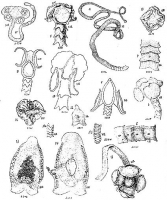
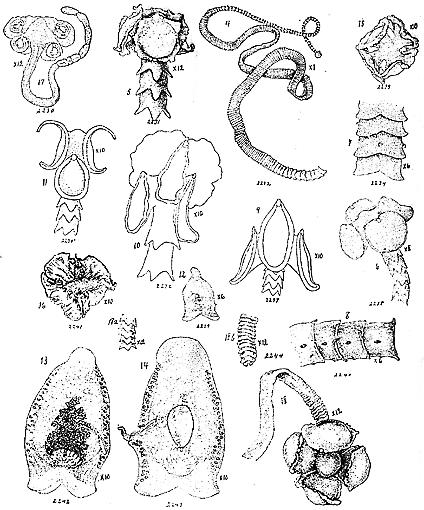 PLATE III. FIGURES 4-18. Crossobothrium laciniatum n. sp. 4. Crossobothrium laciniatum gen. sp. nov., adult strobile, in fresh water, natural size. 5. Head and first segments of same specimen, enlarged 12 diameters. 6. Head and first segments of a specimen after lying for a few minutes in fresh water, enlarged 8 diameters. 7. Posterior segments of same, enlarged 6 diameters. 8. Posterior segments of another specimen, showing lateral openings for the discharge of ova, enlarged 6 diameters. 9. Head and first segments of adult, showing one position of bothria while in motion. The bothrium in front view and the one opposite (not shown in scetch) are thrust foreward, enlarged 10 diameters. 10. The same, with one bothrium flattened out and applied ot the bottom of the watch-glass, enlarged 10 diameters. 11. The same with two bothria pushed forward, the ends extended and curled outward, enlarged 10 diameters. 12. Free proglottis showing lateral opening for discharge of ova, enlarged 6 diameters. 13. Free proglottis before the ova are discharged, flattened under the compressor, enlarged 10 diameters. 14. Another after most of the ova have been discharged from the lateral opening, also flattened under compressor, enlarged 10 diameters. 15. Front view of head of specimen transferred from fresh water to alcohol, enlarged 10 diameters. 16. Transverse section through another specimen, enlarged 10 diameters. 17. Young strobile before segments have made their appearance near the head. The joints at the posterior and are pseudosegmens; flattened under compressor, enlarged12 diameters. 18. Head and anterior part of a young specimen in fresh water, enlarged 12 diameters. 18a. Anterior segments of same, enlarged 12 diameters. 18b. Posterior segments of same, emlarged 12 diameters.
 Best viewed in Firefox