Global Cestode Database
Cestode Scientific Name
| Species ID | 2901 |
|---|---|
| Order | Onchoproteocephalidea II |
| Family | |
| Subfamily | |
| Genus | Acanthobothrium |
| Species | maryanskii |
| Authority | Caira & Burge, 2001 |
| Taxonomic Status | Valid |
| Valid Name | |
| Synonyms | |
| Genus Record | No |
| Type Species | No |
| Verified | No |
| Verified By | |
| Citation(s) |
Caira, J. N. and A. N. Burge. 2001. Three new species of Acanthobothrium (Cestoda: Tetraphyllidea) from the ocellate electric ray, Diplobatis ommata, in the Gulf of California, Mexico. Comparative Parasitology 68: 52-65. (3853) Download PDF |
| Redescription | |
| Scientific Name Notes |
Record Data
| Date (MM/DD/YYYY) | Action | User Name |
|---|---|---|
| 09/09/2006 | Created | K. Jensen |
| 01/29/2015 | Modified | |
| 06/07/2015 | Modified | J. Caira |
| 06/09/2015 | Modified | J. Caira |
| 01/22/2016 | Modified | K. Mojica |
| 09/01/2016 | Modified | K. Jensen |
Type Host
| Host Class | |||||||
|---|---|---|---|---|---|---|---|
| Host Order | Torpediniformes | ||||||
| Host Family | Narcinidae | ||||||
|
Type Host (Literal) |
|
||||||
|
Type Host (Valid) |
|
||||||
| Additional Host(s) | |||||||
| Site in Host | spiral intestine | ||||||
| Host Notes |
Type Locality
| Country | México |
|---|---|
| Body of Water | Gulf of California |
| Island(s) | |
| City/Region | Loreto |
| Coordinates | |
| DD Latitude | 26°01’N |
| DD Longitude | 111°21’W |
| Additional Localities | additional locality: Punta Arena (24°04’N, 109°50’W), Gulf of California, Mexico |
| Locality Notes |
Specimens
| Type Material | CNHE No. 4171 (holotype) CNHE No. 4172 (paratype) LRP Nos. 2012 & 2013 (paratypes) USNPC Nos. 90840 & 90841 (paratypes) |
|---|---|
| Total Number of Type Specimens | 2 incomplete worms with scolices and 5 strobilar fragments |
| Voucher Material | |
| Specimen Notes |
Data are given as in original description unless otherwise indicated.
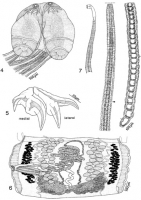

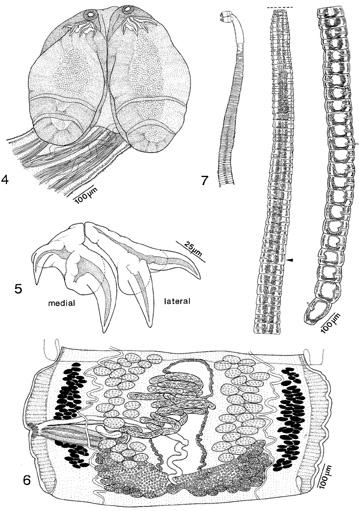 FIGURES 4-7. Acanthobothrium maryanskii n. sp. 1. Scolex. 2. Hooks. 3. Mature proglottid. 7. Whole worm. Arrow indicates location of proglottid drawn in Fig. 6. Note: Because no complete worm was found, in order to provide an indication of the form of a full worm; this figure is a composit of the anterior portion of 1 worm and the posterior portion of another; the dashed line indicates the break between worm fragments.
 Best viewed in Firefox