Global Cestode Database
Cestode Scientific Name
| Species ID | 14436 |
|---|---|
| Order | Trypanorhyncha |
| Family | Rhinoptericolidae |
| Subfamily | |
| Genus | Rhinoptericola |
| Species | mozambiquensis |
| Authority | Herzog & Jensen, 2022 |
| Taxonomic Status | Valid |
| Valid Name | |
| Synonyms | |
| Genus Record | No |
| Type Species | |
| Verified | Yes |
| Verified By | K. S. Herzog |
| Citation(s) |
Herzog, K. S. and K. Jensen. 2022. A synergistic, global approach to revising the trypanorhynch tapeworm family Rhinoptericolidae (Trypanobatoida). PeerJ Life & Environment 10:e12865: 83 pp. (7426) Download PDF |
| Redescription | |
| Scientific Name Notes | urn:lsid:zoobank.org:act:958674CF-3029-4E37-A709-289E0354E2DF |
Record Data
| Date (MM/DD/YYYY) | Action | User Name |
|---|---|---|
| 02/17/2022 | Created | B. Barbeau |
| 02/17/2022 | Modified | B. Barbeau |
| 02/18/2022 | Modified | B. Barbeau |
| 02/21/2022 | Modified | K. Herzog |
| 03/01/2022 | Modified | K. Herzog |
| 05/10/2022 | Modified | K. Herzog |
Type Host
| Host Class | Elasmobranchii | ||||||
|---|---|---|---|---|---|---|---|
| Host Order | Myliobatiformes | ||||||
| Host Family | Rhinopteridae | ||||||
|
Type Host (Literal) |
|
||||||
|
Type Host (Valid) |
|
||||||
| Additional Host(s) | |||||||
| Site in Host | spiral intestine | ||||||
| Host Notes |
Type Locality
| Country | Mozambique |
|---|---|
| Body of Water | Mozambique Channel |
| Island(s) | |
| City/Region | Tofo |
| Coordinates | 23°47'33.02"S, 35°31'16.38"E |
| DD Latitude | |
| DD Longitude | |
| Additional Localities | |
| Locality Notes |
Specimens
| Type Material | Holotype (USNM 1661599), 14 paratypes (USNM 1661596–1661598, USNM 1661600–1661610), and 11 paratypes (LRP 10661–10720) |
|---|---|
| Total Number of Type Specimens | based on five gravid worms, 16 mature worms, one immature worm, cross-sections of one scolex and one partial strobila, and three scoleces and one partial strobila prepared for SEM |
| Voucher Material | LRP 10659–10660 (hologenophores, this study) |
| Specimen Notes |
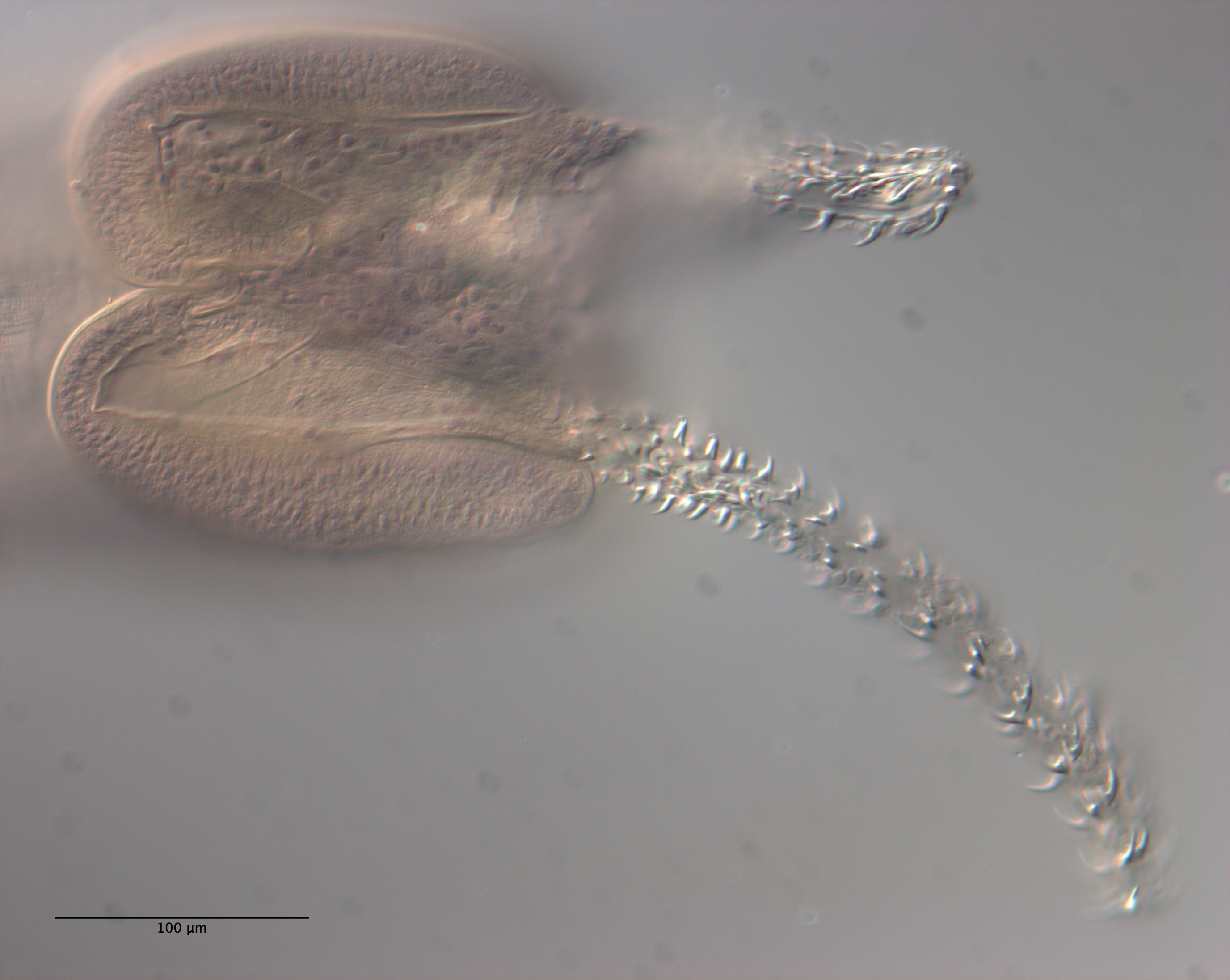
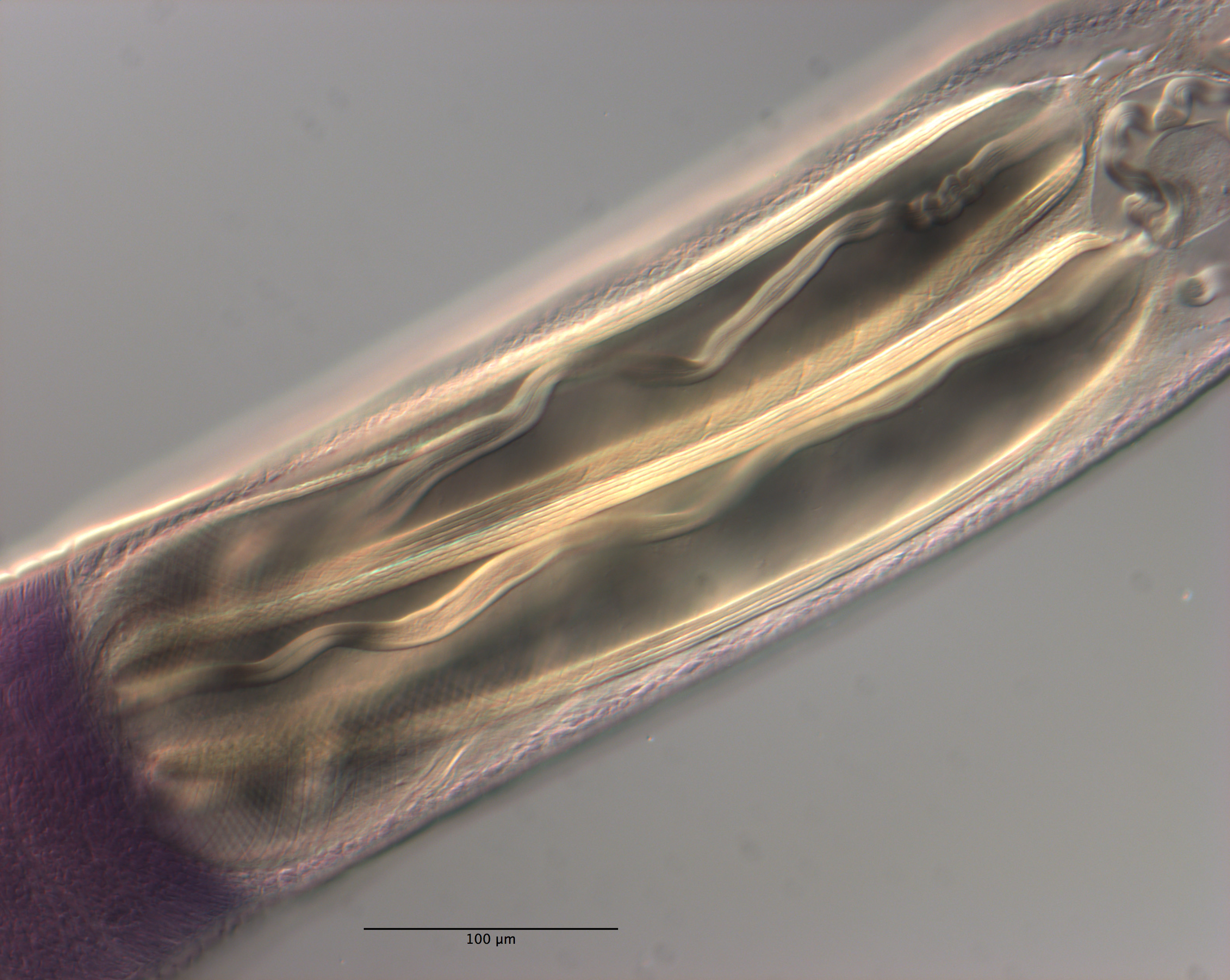
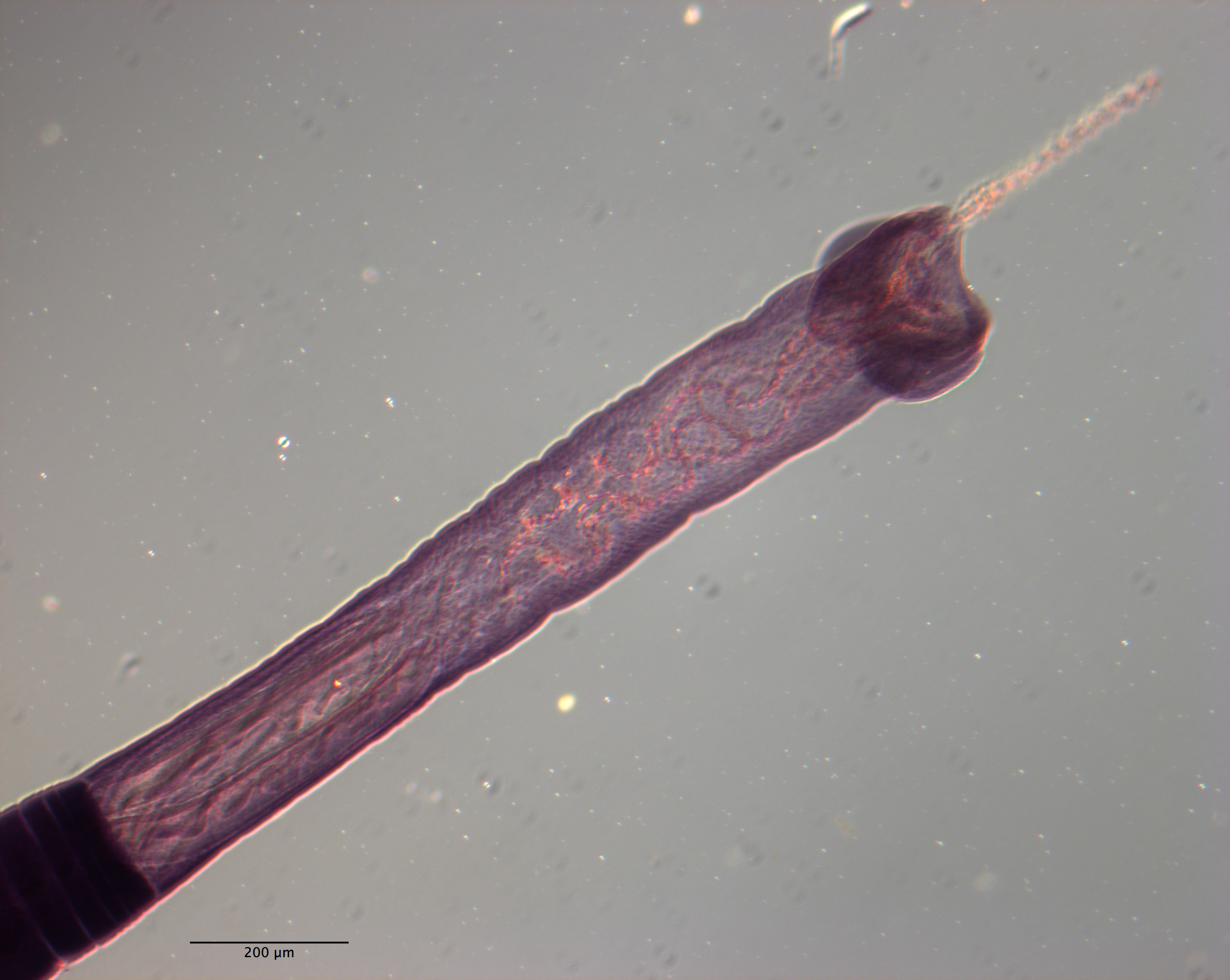
Data are given as in original description unless otherwise indicated.
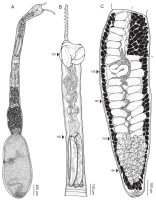
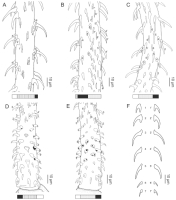
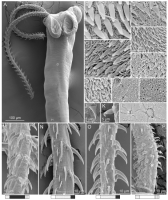
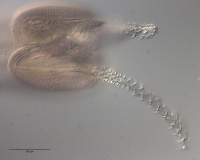
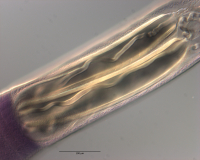
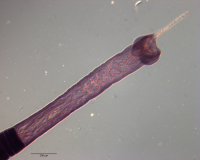
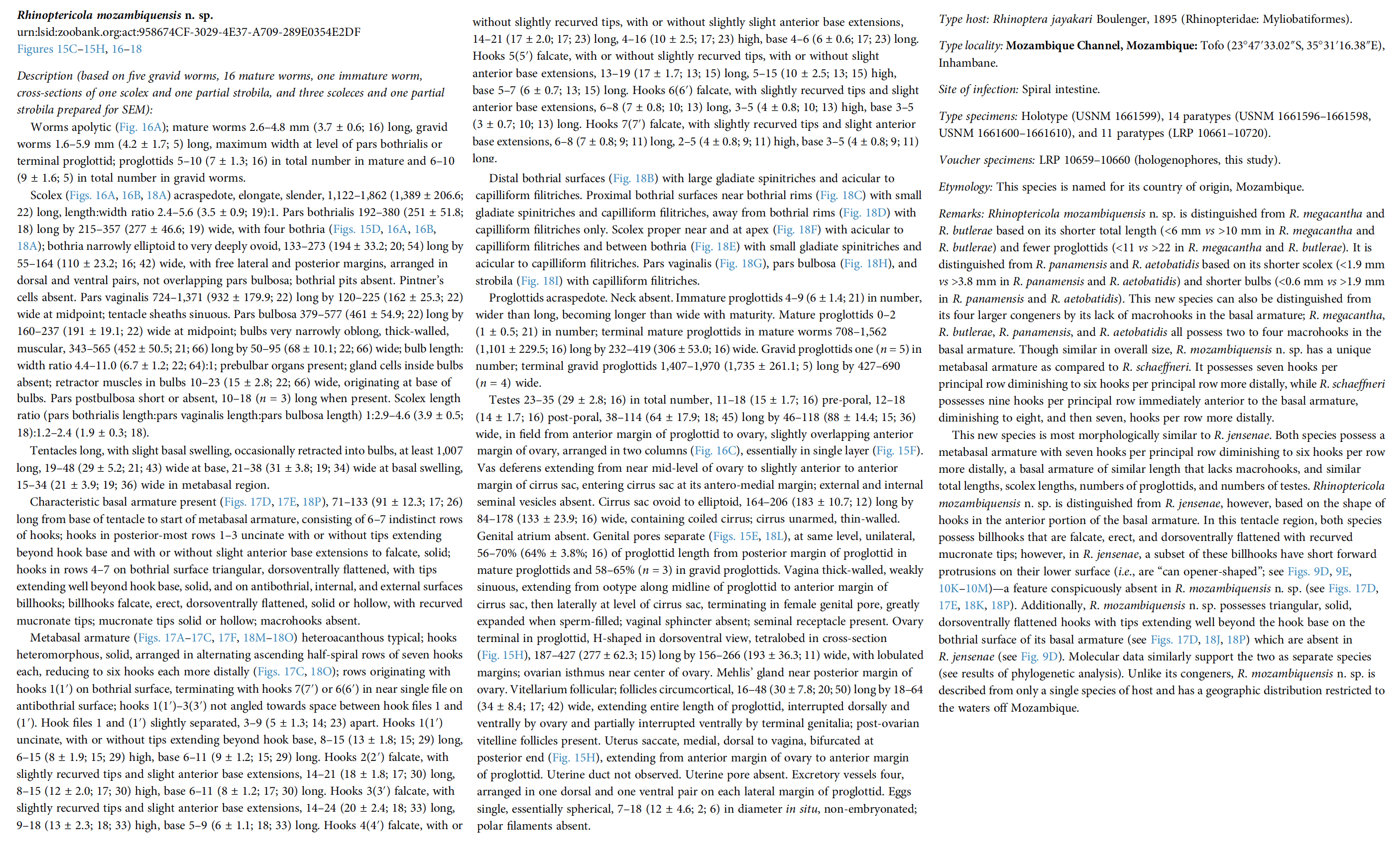
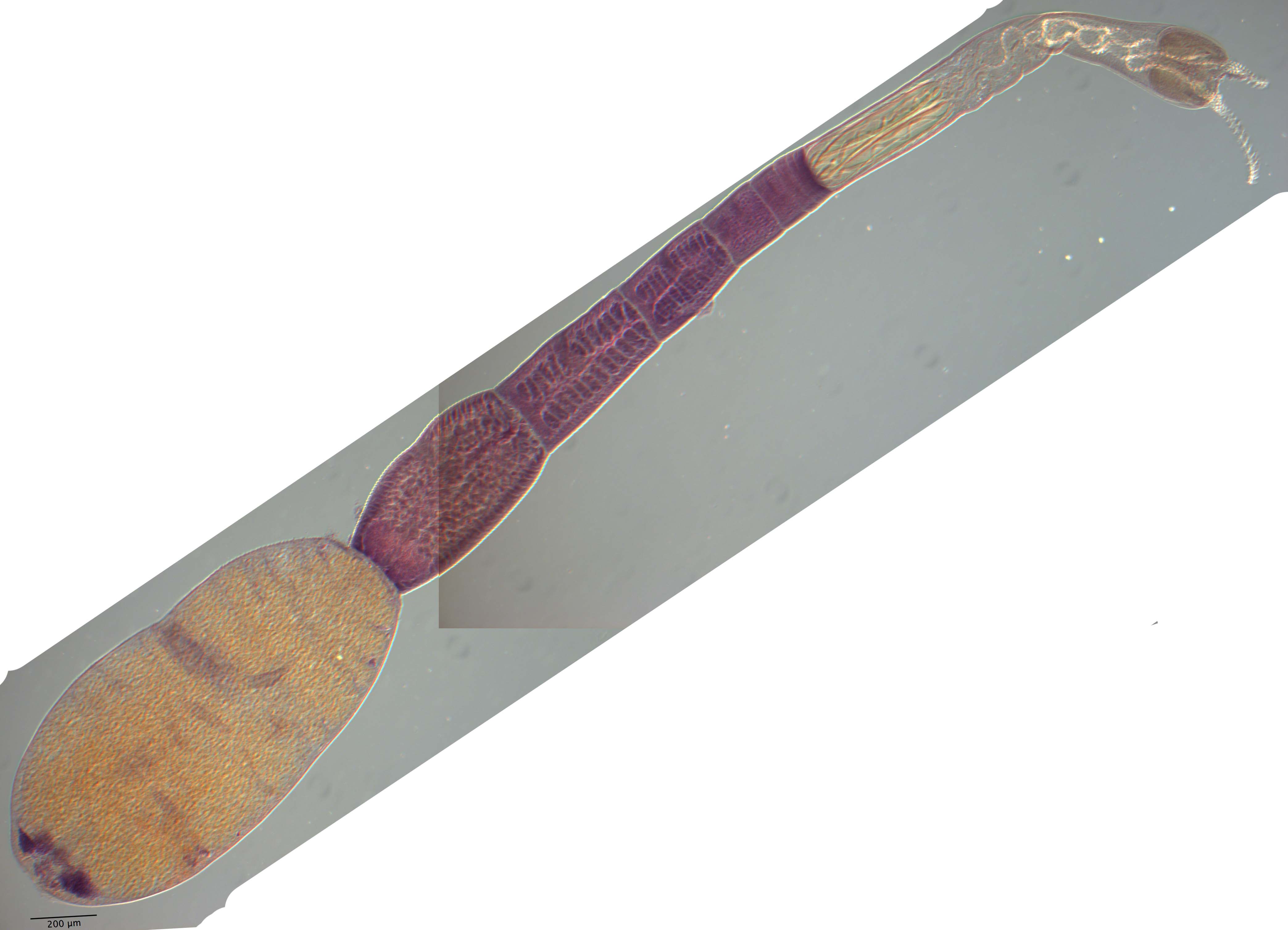
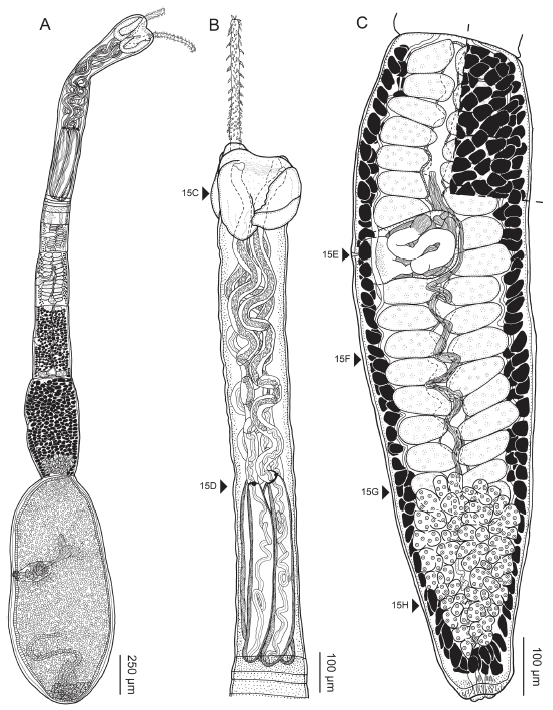 Figure 16 Line drawings of Rhinoptericola mozambiquensis n. sp. (A) Whole worm (USNM 1661599;
holotype). (B) Scolex (USNM 1661596; paratype). (C) Terminal proglottid (USNM 1661598; paratype); circumcortical vitelline follicles are drawn only on the lateral margins and in the region delimited by dashed lines. Arrowheads indicate the level at which the sections in Fig. 15 were taken. Full-size image DOI: 10.7717/peerj.12865/fig-16
Figure 16 Line drawings of Rhinoptericola mozambiquensis n. sp. (A) Whole worm (USNM 1661599;
holotype). (B) Scolex (USNM 1661596; paratype). (C) Terminal proglottid (USNM 1661598; paratype); circumcortical vitelline follicles are drawn only on the lateral margins and in the region delimited by dashed lines. Arrowheads indicate the level at which the sections in Fig. 15 were taken. Full-size image DOI: 10.7717/peerj.12865/fig-16 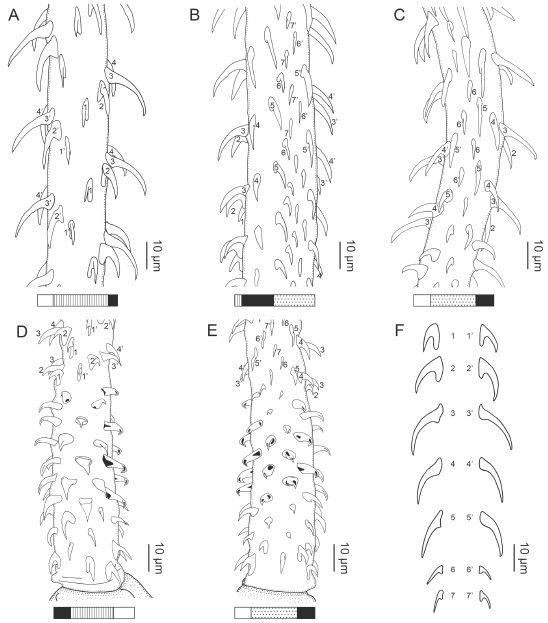 Figure 17 Line drawings of the tentacular armature of Rhinoptericola mozambiquensis n. sp. (A) Metabasal armature, bothrial surface (USNM 1661596; paratype). (B) Metabasal armature, external and antibothrial surfaces (USNM 1661597; paratype). (C) Metabasal armature, antibothrial surface more distal on the tentacle showing a reduction to six hooks per principal row (LRP 10661; paratype).
(D) Basal armature, bothrial surface (LRP 10663; paratype). (E) Basal armature, antibothrial surface (LRP 10663; paratype). (F) Comparison of metabasal hook shapes. Full-size image DOI: 10.7717/peerj.12865/fig-17
Figure 17 Line drawings of the tentacular armature of Rhinoptericola mozambiquensis n. sp. (A) Metabasal armature, bothrial surface (USNM 1661596; paratype). (B) Metabasal armature, external and antibothrial surfaces (USNM 1661597; paratype). (C) Metabasal armature, antibothrial surface more distal on the tentacle showing a reduction to six hooks per principal row (LRP 10661; paratype).
(D) Basal armature, bothrial surface (LRP 10663; paratype). (E) Basal armature, antibothrial surface (LRP 10663; paratype). (F) Comparison of metabasal hook shapes. Full-size image DOI: 10.7717/peerj.12865/fig-17 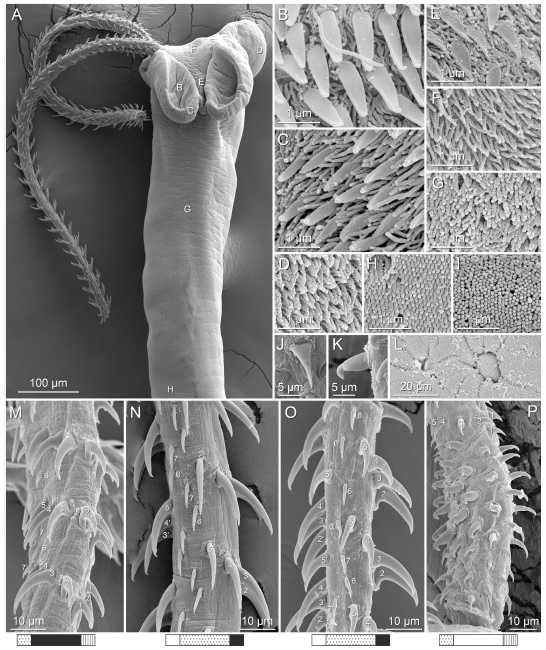 Figure 18 Scanning electron micrographs of Rhinoptericola mozambiquensis n. sp. (A) Scolex; small letters indicate the location of details shown in (B–H). (B) Distal bothrial surface. (C) Proximal bothria
surface near the bothrial rim. (D) Proximal bothria surface away from the bothrial rim. (E) Surface of the scolex proper between the bothria. (F) Surface of the scolex proper at the apex. (G) Surface of the pars vaginalis. (H) Surface of the pars bulbosa. (I) Strobilar surface. (J) Triangular dorsoventrally flattened hook with the tip extending well beyond the hook base on the bothrial surface of the basal armature.
(K) Falcate, erect, dorsoventrally flattened billhook with a mucronate tip on the internal and external surfaces of the basal armature. (L) Separate male and female genital pores. (M) Metabasal armature, external surface. (N) Metabasal armature, antibothrial surface. (O) Metabasal armature, distal antibothrial surface showing the transition from seven to six hooks per principal row. (P) Basal armature, internal surface. Full-size image DOI: 10.7717/peerj.12865/fig-18
Figure 18 Scanning electron micrographs of Rhinoptericola mozambiquensis n. sp. (A) Scolex; small letters indicate the location of details shown in (B–H). (B) Distal bothrial surface. (C) Proximal bothria
surface near the bothrial rim. (D) Proximal bothria surface away from the bothrial rim. (E) Surface of the scolex proper between the bothria. (F) Surface of the scolex proper at the apex. (G) Surface of the pars vaginalis. (H) Surface of the pars bulbosa. (I) Strobilar surface. (J) Triangular dorsoventrally flattened hook with the tip extending well beyond the hook base on the bothrial surface of the basal armature.
(K) Falcate, erect, dorsoventrally flattened billhook with a mucronate tip on the internal and external surfaces of the basal armature. (L) Separate male and female genital pores. (M) Metabasal armature, external surface. (N) Metabasal armature, antibothrial surface. (O) Metabasal armature, distal antibothrial surface showing the transition from seven to six hooks per principal row. (P) Basal armature, internal surface. Full-size image DOI: 10.7717/peerj.12865/fig-18 
Best viewed in Firefox