Global Cestode Database
Cestode Scientific Name
| Species ID | 14174 |
|---|---|
| Order | Phyllobothriidea |
| Family | |
| Subfamily | |
| Genus | Scyphophyllidium |
| Species | ullmanni |
| Authority | (Cutmore, Bennett, Miller, & Cribb, 2017) Caira, Jensen & Ruhnke, 2020 |
| Taxonomic Status | Valid |
| Valid Name | |
| Synonyms | Paraorygmatobothrium ullmanni Cutmore, Bennett, Miller, & Cribb, 2017 |
| Genus Record | No |
| Type Species | No |
| Verified | No |
| Verified By | |
| Citation(s) |
Cutmore, S. C., M. B. Bennett, T. L. Miller, and T. H. Cribb. 2017. Patterns of specificity and diversity in species of Paraorygmatobothrium Ruhnke, 1994 (Cestoda: Phyllobothriidae) in Moreton Bay, Queensland, Australia, with the description of four new species. Systematic Parasitology 94(9): 941–970. (7054) Download PDFCaira, J. N., K. Jensen, C. Hayes and T. R. Ruhnke. 2020. Insights from new cestodes of the crocodile shark, Pseudocarcharias kamoharai (Lamniformes: Pseudocarchariidae), prompt expansion of Scyphophyllidium and syonymization of seven phyllobothriidean genera—at last!. Journal of Helminthology (https://doi.org/10.1017/S0022149X20000036): 1–24. (7164) Download PDF |
| Redescription | |
| Scientific Name Notes | urn:lsid:zoobank.org:act:296C64B3-02E1-4AD7-BB3F-A529B2D353AC |
Record Data
| Date (MM/DD/YYYY) | Action | User Name |
|---|---|---|
| 07/13/2020 | Created | B. Barbeau |
| 07/13/2020 | Modified | B. Barbeau |
| 07/16/2020 | Modified | B. Barbeau |
Type Host
| Host Class | Elasmobranchii | ||||||
|---|---|---|---|---|---|---|---|
| Host Order | Carcharhiniformes | ||||||
| Host Family | Carcharhinidae | ||||||
|
Type Host (Literal) |
|
||||||
|
Type Host (Valid) |
|
||||||
| Additional Host(s) | Carcharhinus amboinensis | ||||||
| Site in Host | spiral intestine | ||||||
| Host Notes |
Type Locality
| Country | Australia |
|---|---|
| Body of Water | western Moreton Bay |
| Island(s) | |
| City/Region | |
| Coordinates | 27°22'S, 153°13'E |
| DD Latitude | |
| DD Longitude | |
| Additional Localities | |
| Locality Notes |
Specimens
| Type Material | Holotype (QM G233227) and 16 paratypes (QM G233228–43) |
|---|---|
| Total Number of Type Specimens | 17 |
| Voucher Material | |
| Specimen Notes | Representative DNA sequences: 28S rDNA, 9 identical replicates |
Data are given as in original description unless otherwise indicated.
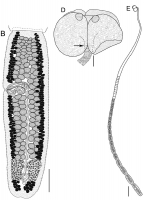
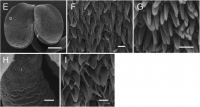
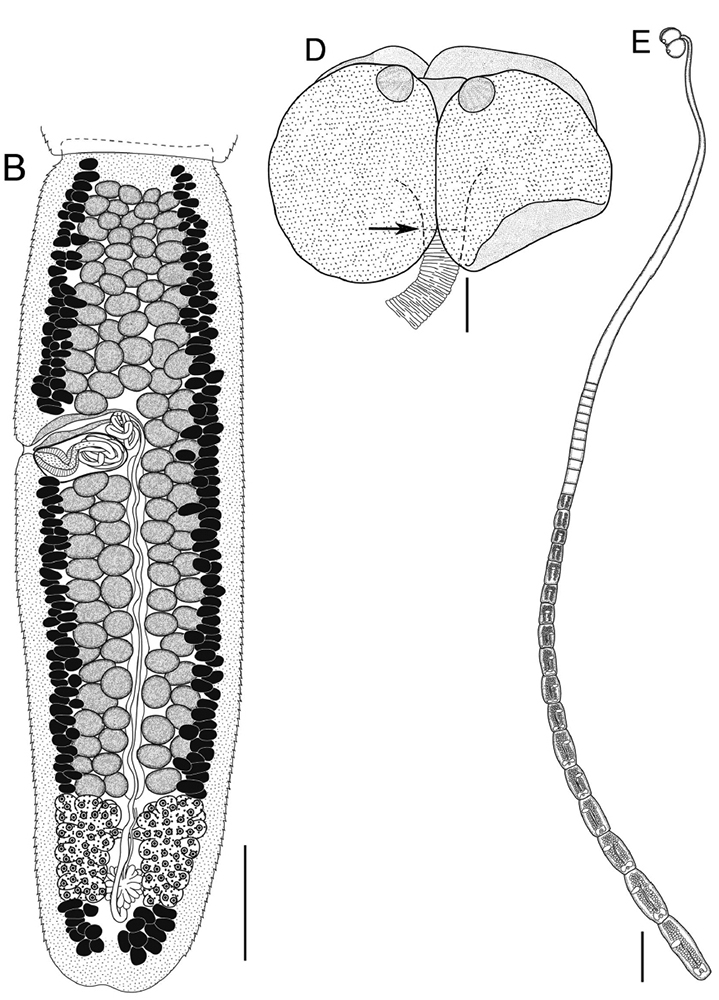 Fig. 1 Species of Paraorygmatobothrium from Moreton Bay, Australia, whole worms. E, Paraorygmatobothrium ullmanni n. sp. ex Carcharhinus cautus (holotype QM G233227); scale-bar: 1 mm. Fig. 2 Species of Paraorygmatobothrium from Moreton Bay, Australia, scoleces. D, Paraorygmatobothrium ullmanni n. sp. ex Carcharhinus cautus (holotype QM G233227); black arrow in D indicates posterior margin of cephalic peduncle; scale-bar: D, 100 µm. Fig. 5 Species of Paraorygmatobothrium from Moreton Bay, terminal proglottides. B, Paraorygmatobothrium ullmanni n. sp. ex Carcharhinus cautus (paratype QM
G233228); scale-bar: B, 200 µm.
Fig. 1 Species of Paraorygmatobothrium from Moreton Bay, Australia, whole worms. E, Paraorygmatobothrium ullmanni n. sp. ex Carcharhinus cautus (holotype QM G233227); scale-bar: 1 mm. Fig. 2 Species of Paraorygmatobothrium from Moreton Bay, Australia, scoleces. D, Paraorygmatobothrium ullmanni n. sp. ex Carcharhinus cautus (holotype QM G233227); black arrow in D indicates posterior margin of cephalic peduncle; scale-bar: D, 100 µm. Fig. 5 Species of Paraorygmatobothrium from Moreton Bay, terminal proglottides. B, Paraorygmatobothrium ullmanni n. sp. ex Carcharhinus cautus (paratype QM
G233228); scale-bar: B, 200 µm. 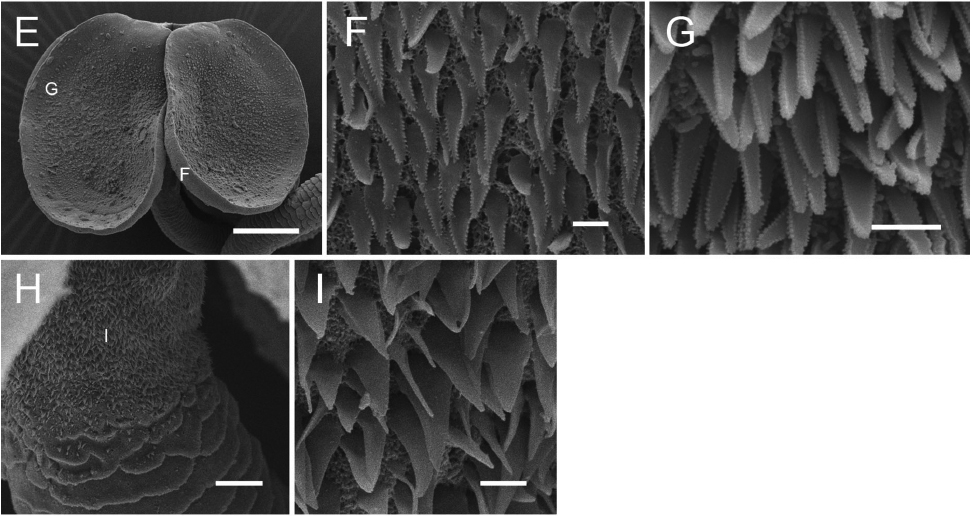 Fig. 6 Species of Paraorygmatobothrium from Moreton Bay, scanning electron micrographs. E–I Paraorygmatobothrium ullmanni n. sp. ex Carcharhinus amboinensis (E, F, H and I) and Carcharhinus cautus (G). E, Scolex, letters indicates where F and G were taken; F, Proximal bothridial surface; G, Distal bothridial surface; H, Cephalic peduncle, letter indicates where I was taken; I, Cephalic peduncle surface. Scale-bars: E, 100 µm; F, G, I, 1 µm; H, 10 µm.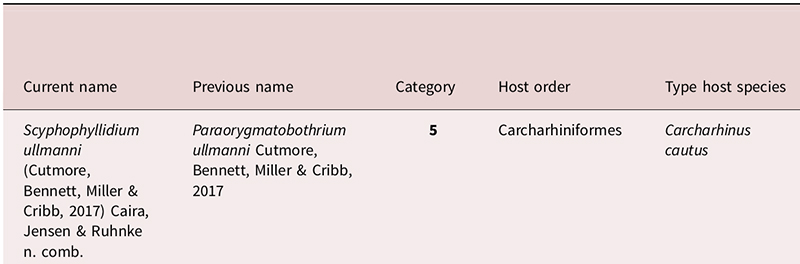
Best viewed in Firefox