Global Cestode Database
Cestode Scientific Name
| Species ID | 14142 |
|---|---|
| Order | Phyllobothriidea |
| Family | |
| Subfamily | |
| Genus | Scyphophyllidium |
| Species | deburonae |
| Authority | (Ruhnke, Daniel & Jensen, 2020) Caira, Jensen & Ruhnke, 2020 |
| Taxonomic Status | Valid |
| Valid Name | |
| Synonyms | Paraorygmatobothrium deburonae Ruhnke, Daniel & Jensen, 2020 |
| Genus Record | No |
| Type Species | No |
| Verified | No |
| Verified By | |
| Citation(s) |
Caira, J. N., K. Jensen, C. Hayes and T. R. Ruhnke. 2020. Insights from new cestodes of the crocodile shark, Pseudocarcharias kamoharai (Lamniformes: Pseudocarchariidae), prompt expansion of Scyphophyllidium and syonymization of seven phyllobothriidean genera—at last!. Journal of Helminthology (https://doi.org/10.1017/S0022149X20000036): 1–24. (7164) Download PDFRuhnke, T. R., V. Daniel, and K. Jensen. 2020. Four new species of Paraorygmatobothrium (Eucestoda: Phyllobothriidea) from sharks of the Gulf of Mexico and the Atlantic Ocean with comments on their host specificity. Journal of Parasitology 106: 133–156. (7187) Download PDF |
| Redescription | |
| Scientific Name Notes |
Record Data
| Date (MM/DD/YYYY) | Action | User Name |
|---|---|---|
| 07/09/2020 | Created | B. Barbeau |
| 07/09/2020 | Modified | B. Barbeau |
| 07/14/2020 | Modified | B. Barbeau |
Type Host
| Host Class | Elasmobranchii | ||||||
|---|---|---|---|---|---|---|---|
| Host Order | |||||||
| Host Family | |||||||
|
Type Host (Literal) |
|
||||||
|
Type Host (Valid) |
|
||||||
| Additional Host(s) | Carcharhinus brevipinna; Carcharhinus limbatus; Rhizoprionodon terraenovae | ||||||
| Site in Host | spiral intestine | ||||||
| Host Notes |
Type Locality
| Country | U.S.A. |
|---|---|
| Body of Water | Gulf of Mexico |
| Island(s) | Round Island |
| City/Region | Mississippi |
| Coordinates | 30° 17' 42.5N, 88° 35' 11.55W |
| DD Latitude | |
| DD Longitude | |
| Additional Localities | Gulf of Mexico, Florida, Indian Pass (29° 40' 8.05" N, 85° 13' 30.17" W) (C. limbatus; C. isodon)); Gulf of Mexico, Mississippi, Horn Island (30° 14' 37.70" N, 88° 46' 37.62" W) (R. terraenovae; C. limbatus) and south of Shallow Fields (29° 37.38" N, 88° 30' 11" W); Atlantic Ocean, South Carolina, Bulls Bay (C. limbatus; C. isodon). |
| Locality Notes |
Specimens
| Type Material | USNM 1594967 (holotype); USNM 1594968–1594974 (7 paratypes, whole worms); LRP 10085–10090 (6 paratypes, whole worms); LRP 7144–7145, 7160, 7162–7164, 7174–7175, 7177, 7196–7197, 10093–10099 (18 hologenophores) |
|---|---|
| Total Number of Type Specimens | 32 |
| Voucher Material | LRP 10091-10092 (2 SEM vouchers) |
| Specimen Notes | Additional specimens deposited: LRP 7158–7159, 7161, 7165, 7176, 7178, 7198, 10100 (8 hologenophores) |
Data are given as in original description unless otherwise indicated.
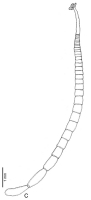
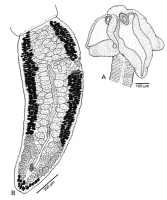
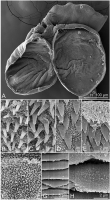
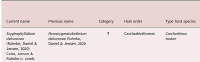
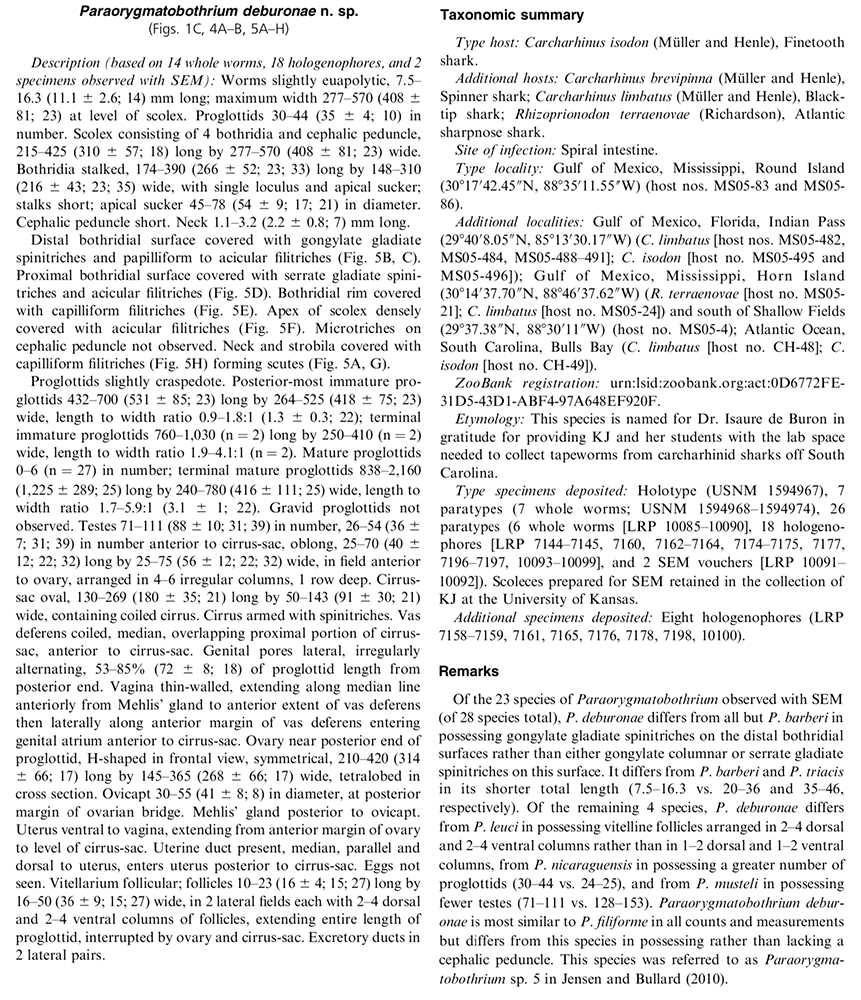
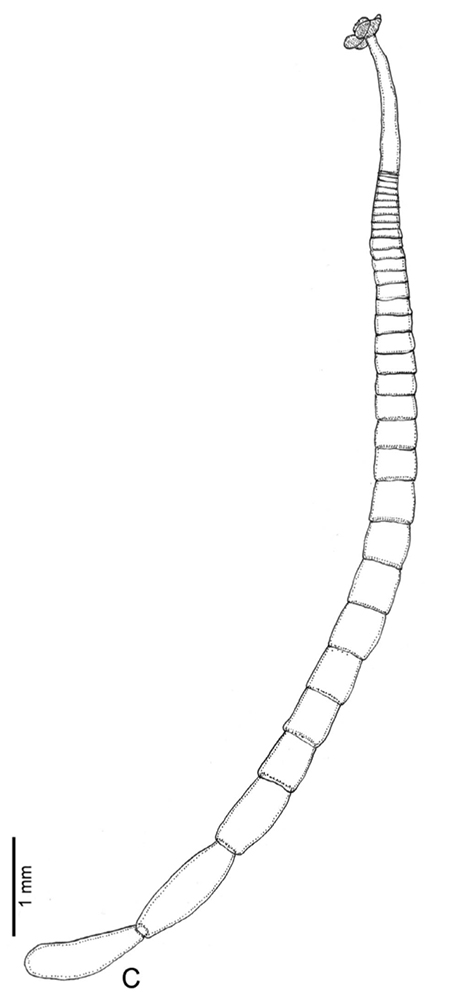 Figure 1. Line drawings (to scale) of whole worms of new species of Paraorygmatobothrium. (C) Paraorygmatobothrium deburonae n. sp. (holotype; USNM 1594967).
 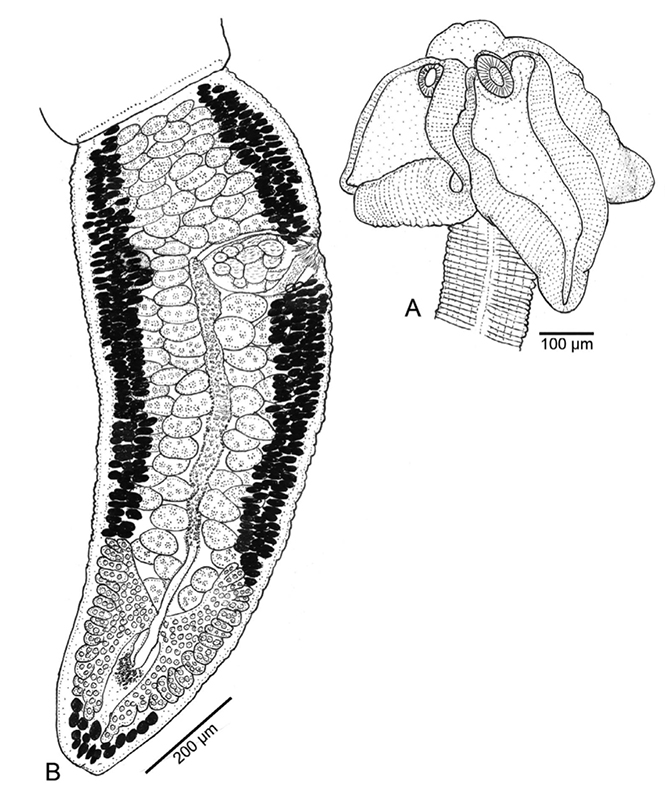 Figure 4. Line drawings of scolex and terminal proglottid of (A, B) Paraorygmatobothrium deburonae n. sp. (A) Scolex (paratype; LRP 7162). (B) Terminal, mature proglottid (paratype; LRP 7162).
 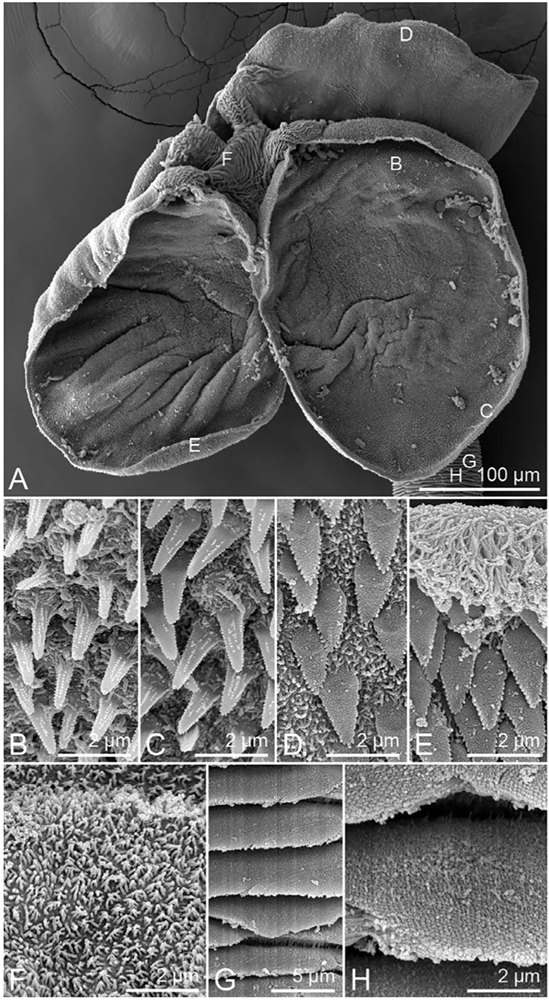 Figure 5. Scanning electron micrographs of (A–H) Paraorygmatobothrium deburonae n. sp. and (I–P) Paraorygmatobothrium mattisi n. sp. (A) Scolex; small letters indicate locations of details in B–H. (B) Distal bothridial surface. (C) Distal bothridial surface near rim. (D) Proximal bothridial surface. (E) Proximal bothridial surface near rim. (F) Surface of scolex proper at apex of scolex. (G) Scutes. (H) Detail of scutes.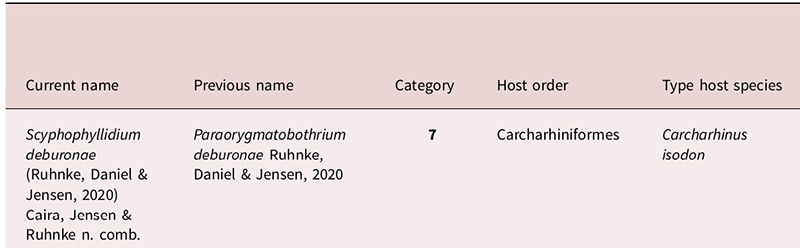
Best viewed in Firefox