Global Cestode Database
Cestode Scientific Name
| Species ID | 13943 |
|---|---|
| Order | Diphyllobothriidea |
| Family | Diphyllobothriidae |
| Subfamily | |
| Genus | Dibothriocephalus |
| Species | nihonkaiensis |
| Authority | (Yamane, Kamo, Bylund & Wikgren, 1986) Waeschenbach, Brabec, Scholz, Littlewood & Kuchta, 2017 |
| Taxonomic Status | Valid |
| Valid Name | |
| Synonyms | Diphyllobothrium nihonkaiense Yamane, Kamo, Bylund & Wikgren, 1986 |
| Genus Record | No |
| Type Species | No |
| Verified | No |
| Verified By | |
| Citation(s) |
Yamane, Y., H. Kamo, G. Bylund, B.-J.P. Wikgren. 1986. Diphyllobothrium nihonkaiense sp. nov. (Cestoda: Diphyllobothriidae) – revised identification of Japanese broad tapeworm. Shimane Journal of Medical Science 10: 29–48. (6556) Download PDFWaeschenbach, A., J. Brabec, T. Scholz, D. T. J. Littlewood, and R. Kuchta. 2017. The catholic taste of broad tapeworms – multiple routes to human infectio. International Journal for Parasitology 47: 831–843. (7057) Download PDF |
| Redescription | |
| Scientific Name Notes |
Record Data
| Date (MM/DD/YYYY) | Action | User Name |
|---|---|---|
| 01/04/2018 | Created | R. Kuchta |
| 01/04/2018 | Modified | R. Kuchta |
| 04/04/2023 | Modified | R. Kuchta |
Type Host
| Host Class | Mammalia | ||||||
|---|---|---|---|---|---|---|---|
| Host Order | Primates | ||||||
| Host Family | Hominidae | ||||||
|
Type Host (Literal) |
|
||||||
|
Type Host (Valid) |
|
||||||
| Additional Host(s) | experimental host: Mesocricetus auratus first intermediate host: Oncorhynchus masou, Oncorhynchus gorbuscha | ||||||
| Site in Host | small intestine | ||||||
| Host Notes |
Type Locality
| Country | Japan |
|---|---|
| Body of Water | |
| Island(s) | Hokkaido |
| City/Region | |
| Coordinates | |
| DD Latitude | |
| DD Longitude | |
| Additional Localities | |
| Locality Notes |
Specimens
| Type Material | - HLS7903 (holotype) - PSH8509-1, 2 (paratypes) |
|---|---|
| Total Number of Type Specimens | |
| Voucher Material | |
| Specimen Notes | -deposited at Department of Medical Zoology, Tottori University School of Medicine, Yonago City 683, Japan |
Data are given as in original description unless otherwise indicated.
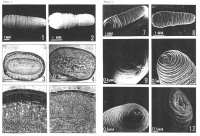
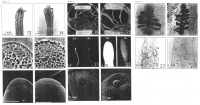
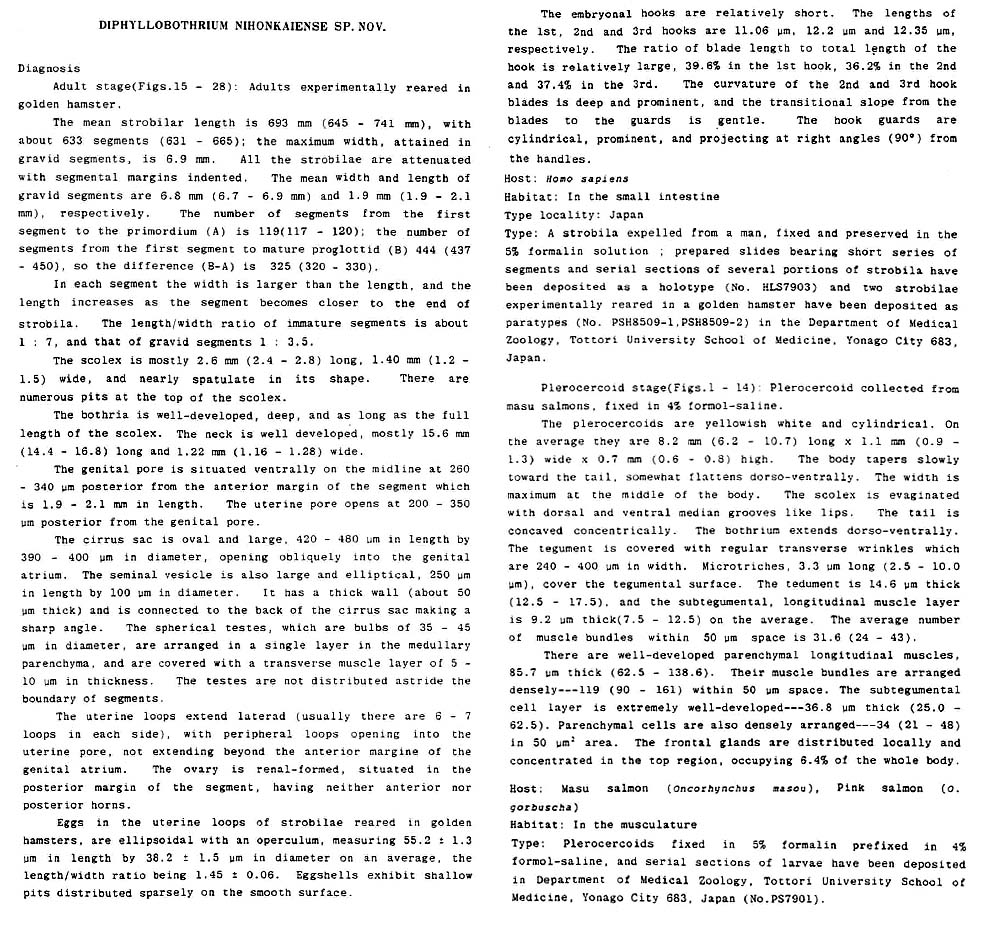
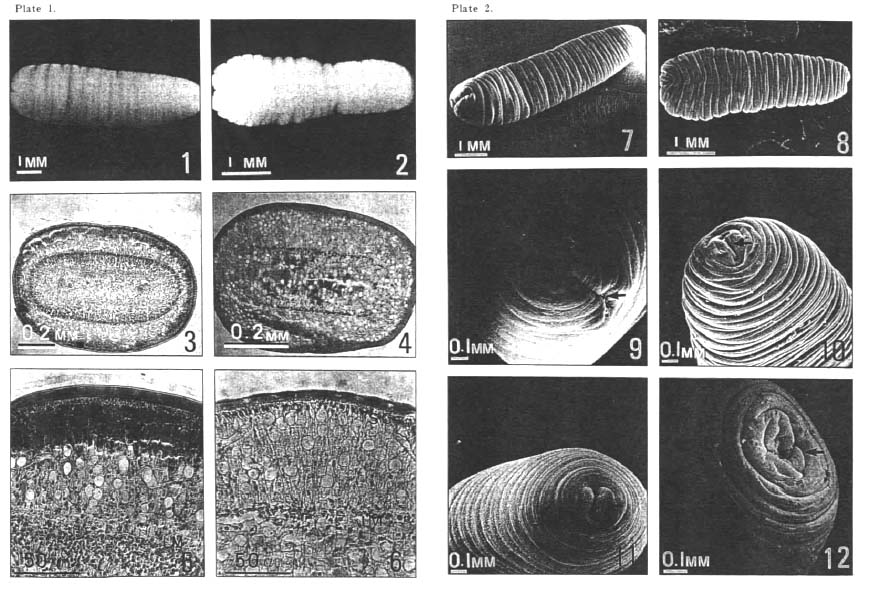 Plate 1. Plerocercoids of D. nihonkainese (left) and D. latum (right). Figs. l, 2. Plerocercoids fixed in 4% formol-saline. 8x. 15x. Figs. 3, 4. Cross sections of the middle part of plerocercoids. 55x, 110x. Figs. 5, 6. Cross sections showing the subtegumental cell layer (SC) and the parenchymal longitudinal muscle layer (LM). 400x. Plate 2. SEM photos of plerocercoids of D. nihonkaiense (left) and D. latum (right). Figs. 7, 8. Whole-length plerocercoids. 10x, 15x. Figs, 9, 10. Head part of plerocercoids showing bothria (arrows). 50x. Figs. 11, 12. Tail part of plerocercoids showing the concaves (arrows). 50x, 70x.
 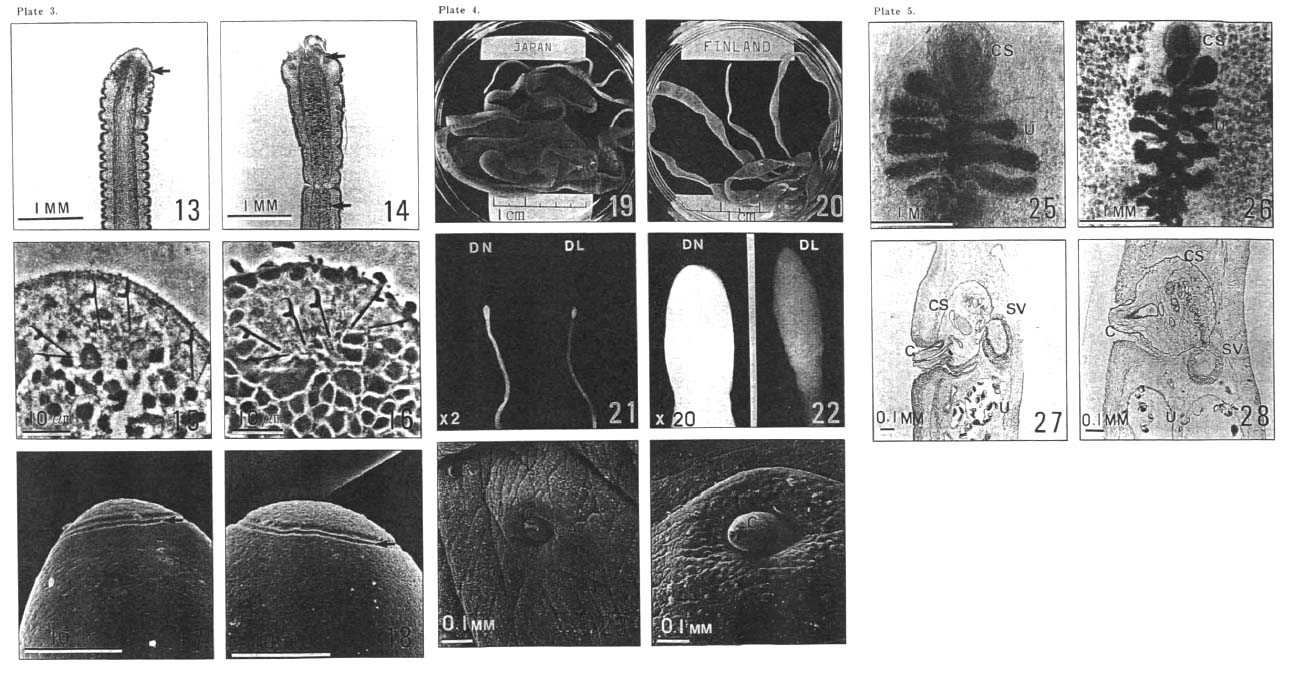 Plate 3. Frontal glands, embryonal hooks and eggshellls of D. nihonkaiense (left) and D. latum (right).Figs. 13, 14. Head part of plerocercoids showing the distribution of frontal glands (arrows). 20x. Figs. 15, 16. Three pairs of emoryona hooks in coracidia. 1.500x. Figs. 17, 18. SEM photos of eggshells showing pits and opercular sutures (arrows). 3.000x. Plate 4. Adult stage of D. nihonkaiense (left, DN) and D. latum (right, DL). Figs. 19, 20. Whole strobilae collected from the golden hamsters. Figs. 21, 22. Scoleces and neck of adult worms. 2x, 10x. Figs. 23, 24. SEMl photos of proglottides showing cirrus (C), genital atrium (GA), uterine pore (UP) and genital papillae (GP). 1.000x. Plate 5. Proglottides of D. nihonkainese (left) and D. latum (right). Figs. 25, 26. Whole-mounted specimens of segments showing uterus (U) and cirrus sac (CS). 25x. Figs. 27, 28. Sagital sections of mature segments showing cirrus (C), cirrus sac (CS), seminal vesicle (SV) and utsrus (U). 50x.
Best viewed in Firefox