Global Cestode Database
Cestode Scientific Name
| Species ID | 13467 |
|---|---|
| Order | Tetraphyllidea |
| Family | Calliobothriidae |
| Subfamily | |
| Genus | Symcallio |
| Species | leuckarti |
| Authority | (van Beneden, 1850) Bernot, Caira & Pickering, 2015 |
| Taxonomic Status | Valid |
| Valid Name | |
| Synonyms | Calliobothrium leuckarti Van Beneden, 1850 |
| Genus Record | No |
| Type Species | No |
| Verified | Yes |
| Verified By | J. P. Bernot |
| Citation(s) |
van Beneden, P.-J. 1850. Recherches sur la faune littorale de Belgique. Les vers cestoides, considérés sous le rapport physiologique, embryogénique et zooclassique. Mémoires de l‘Academie Royale des Sciences, des Lettres et des Beaux-Arts de Belgique 25: 1-199 (+plates). (472) Download PDFBernot, J. P., J. N. Caira, and M. Pickering. 2015. The dismantling of Calliobothrium (Cestoda: Tetraphyllidea) with erection of Symcallio n. gen. and description of two new species. Journal of Parasitology 101(2): 167–181. (6504) Download PDF |
| Redescription |
Bernot, J. P., J. N. Caira, and M. Pickering. 2016. Diversity, phylogenetic relationships, and host associations of Callibothrium and Symcallio (Cestoda: 'Tetraphyllidea') parasitizing triakid sharks. Invertebrate Systematics 30(6): 616–634. (6983) Download PDF |
| Scientific Name Notes | the first use of this specific name was by Van Beneden (1850) in the genus Acanthobothrium but was not accompanied by a description and thus is a nomen nudum in the text of Van Beneden (1850) he makes no reference to this name but uses the name Calliobothrium leuckaertii “leuckaertii” is the spelling Van Beneden (1850) uses for the specific name to honor Leuckart. He apparently misspelled “Leuckaert”; the correct spelling should be “leuckartii” the second “i” was formally dropped by Nasin, Caira & Euzet (1997) |
Record Data
| Date (MM/DD/YYYY) | Action | User Name |
|---|---|---|
| 06/07/2015 | Created | J. Caira |
| 06/07/2015 | Modified | J. Caira |
| 06/13/2015 | Modified | J. Caira |
| 09/17/2015 | Modified | N. Arisco |
| 01/13/2016 | Modified | J. Caira |
| 01/19/2016 | Modified | K. Jensen |
| 01/20/2016 | Modified | K. Mojica |
| 09/20/2016 | Modified | K. Jensen |
| 08/07/2017 | Modified | K. Gallagher |
| 01/27/2020 | Modified | P. Lopez Dineen |
| 11/02/2020 | Modified | B. Barbeau |
Type Host
| Host Class | |||||||
|---|---|---|---|---|---|---|---|
| Host Order | Carcharhiniformes | ||||||
| Host Family | Triakidae | ||||||
|
Type Host (Literal) |
|
||||||
|
Type Host (Valid) |
|
||||||
| Additional Host(s) | |||||||
| Site in Host | spiral intestine | ||||||
| Host Notes |
Type Locality
| Country | Belgium |
|---|---|
| Body of Water | North Sea |
| Island(s) | |
| City/Region | |
| Coordinates | |
| DD Latitude | |
| DD Longitude | |
| Additional Localities | North Sea (52° 28' 32.7144 N, 1° 45' 20.4372" E) off Lowestoft, United Kingdom |
| Locality Notes |
Specimens
| Type Material | NHMUK 2016.5.13.6 (neotype) |
|---|---|
| Total Number of Type Specimens | Not given in original description |
| Voucher Material | one voucher (USNM No. 1404448); three vouchers (LRP Nos. 8892–8894), three slides of individual bothridia of one voucher (LRP Nos. 8899–8901), strobilar voucher of one voucher examined with SEM (LRP Nos. 8895), scolex and strobilar vouchers of two holo |
| Specimen Notes | Type material not indicated in original description |
Data are given as in original description unless otherwise indicated.
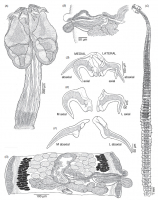
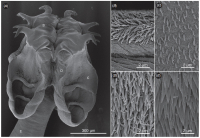
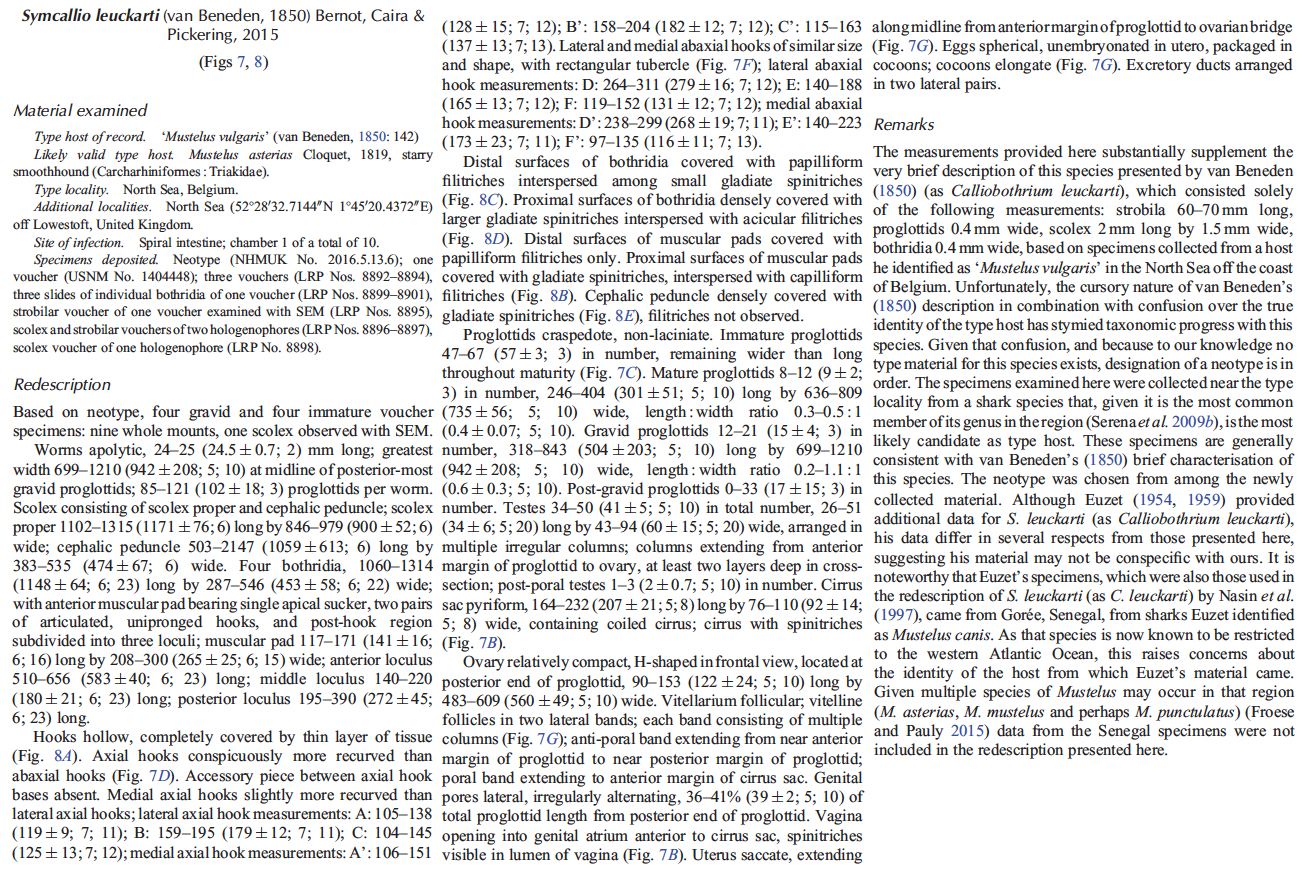 From Bernot et al, 2016 (Cit #6983)
 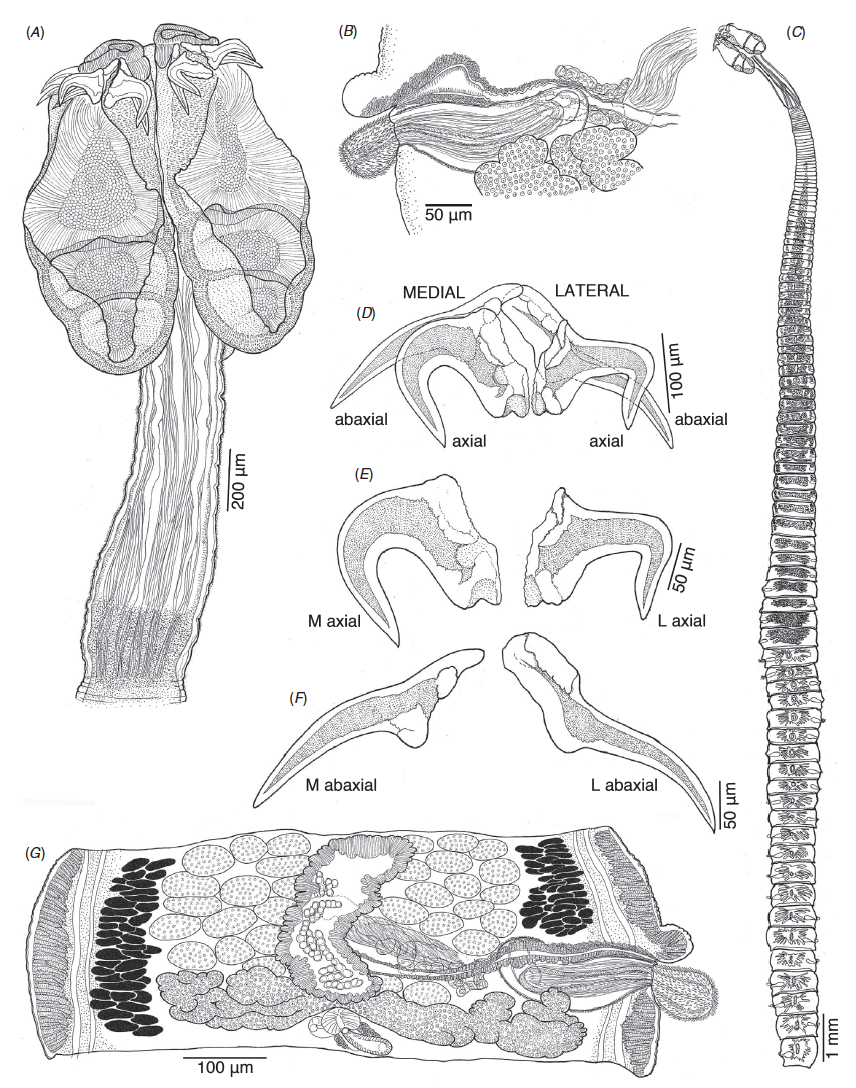 From Bernot et al, 2016 (Cit #6983); Fig. 7. Line drawings of Symcallio leuckarti. (A) Scolex (neotype NHMUK 2016.5.13.6); (B) terminal genitalia (voucher LRP 8896); (C) gravid worm
(neotype NHMUK 2016.5.13.6); (D) detail of medial and lateral hooks (voucher LRP 8893); (E) detail of axial hooks; (F) detail of abaxial hooks;
(G) gravid proglottid (voucher LRP 8896). Abbreviations: L, lateral; M, medial.
From Bernot et al, 2016 (Cit #6983); Fig. 7. Line drawings of Symcallio leuckarti. (A) Scolex (neotype NHMUK 2016.5.13.6); (B) terminal genitalia (voucher LRP 8896); (C) gravid worm
(neotype NHMUK 2016.5.13.6); (D) detail of medial and lateral hooks (voucher LRP 8893); (E) detail of axial hooks; (F) detail of abaxial hooks;
(G) gravid proglottid (voucher LRP 8896). Abbreviations: L, lateral; M, medial. 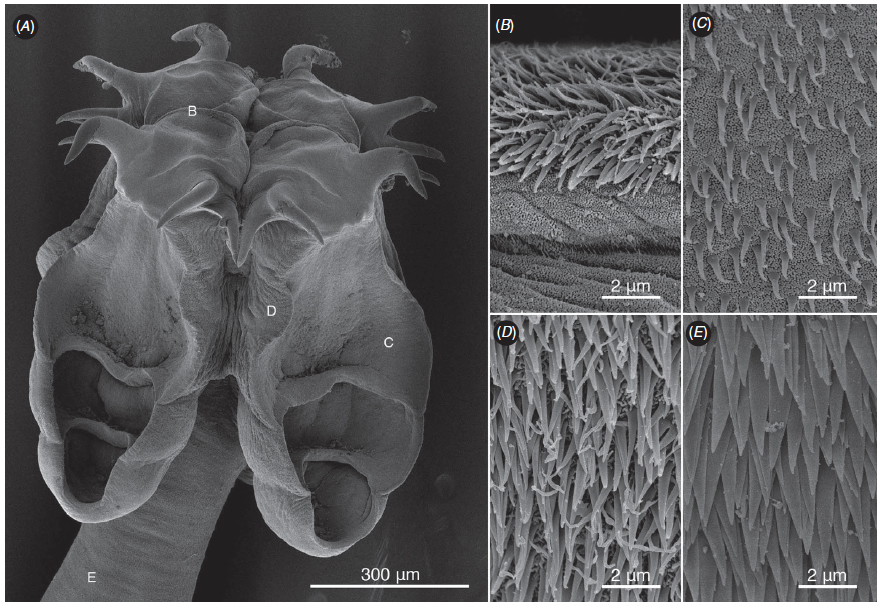 From Bernot et al, 2016 (Cit #6983); Fig. 8. Scanning electron micrographs of Symcallio leuckarti. (A) Scolex; letters indicate location of details in micrographs B–E; (B) microtriches on distal and proximal surfaces of muscular pad; (C) microtriches on distal surface of anterior loculus; (D) microtriches on proximal surface of bothridium; (E) microtriches on cephalic peduncle.
Best viewed in Firefox