Global Cestode Database
Cestode Scientific Name
| Species ID | 12891 |
|---|---|
| Order | Lecanicephalidea |
| Family | Polypocephalidae |
| Subfamily | |
| Genus | Seussapex |
| Species | karybares |
| Authority | Jensen & Russell, 2014 |
| Taxonomic Status | Valid |
| Valid Name | |
| Synonyms | |
| Genus Record | No |
| Type Species | Yes |
| Verified | No |
| Verified By | |
| Citation(s) |
Jensen, K and S. L. Russell. 2014. Seussapex, a new genus of lecanicephalidean tapeworm (Platyhelminthes: Cestoda) from the stingray genus Himantura (Myliobatiformes: Dasyatidae) in the Indo-West Pacific with investigation of mode of attachment. Folia Parasitologica 61(3): 231-241. (6410) Download PDF |
| Redescription | |
| Scientific Name Notes |
Record Data
| Date (MM/DD/YYYY) | Action | User Name |
|---|---|---|
| 07/28/2014 | Created | N. Arisco |
| 01/09/2016 | Modified | K. Jensen |
| 01/13/2016 | Modified | K. Mojica |
| 01/15/2016 | Modified | K. Jensen |
| 06/09/2016 | Modified | K. Jensen |
| 08/07/2017 | Modified | K. Jensen |
Type Host
| Host Class | Elasmobranchii | ||||||
|---|---|---|---|---|---|---|---|
| Host Order | Myliobatiformes | ||||||
| Host Family | Dasyatidae | ||||||
|
Type Host (Literal) |
|
||||||
|
Type Host (Valid) |
|
||||||
| Additional Host(s) | |||||||
| Site in Host | spiral intestine | ||||||
| Host Notes | host ID sensu Naylor et al. (2012) |
Type Locality
| Country | Australia |
|---|---|
| Body of Water | Timor Sea |
| Island(s) | |
| City/Region | Northern Territory |
| Coordinates | |
| DD Latitude | -12.336 |
| DD Longitude | 130.911 |
| Additional Localities | Dundee Beach at Fog Bay (12°45'33''S; 130°21'7''E), Northern Territory, Australia, Timor Sea; Weipa (12°35'11''S; 141°42'34''E), Queensland, Australia, Gulf of Carpentaria. |
| Locality Notes | Type Locality: Buffalo Creek at Lee Point |
Specimens
| Type Material | QM G234324 (holotype) and QM G234320–G234323, G234325–234330 (ten paratypes: six whole worms, two scolex longitudinal section series, both PAS-stained, one proglottid cross section series and one lactophenol egg preparation including specimen voucher); IPCAS C–649 (one paratype); USNPC 107776–107779 (eight paratypes: six whole worms, one scolex longitudinal section series, PAS-stained, including strobilar voucher and one lactophenol egg preparation); LRP 8354–8362 (six paratypes: four whole worms, one scolex longitudinal section series, PAS-stained); six scoleces prepared for SEM strobila vouchers for three of those retained in the collection of KJ at the University of Kansas. |
|---|---|
| Total Number of Type Specimens | Based on 31 specimens |
| Voucher Material | |
| Specimen Notes |
Data are given as in original description unless otherwise indicated.
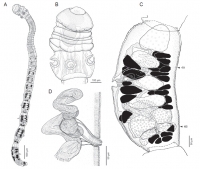
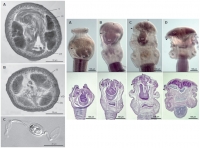
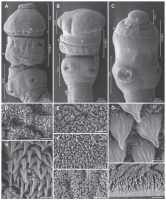
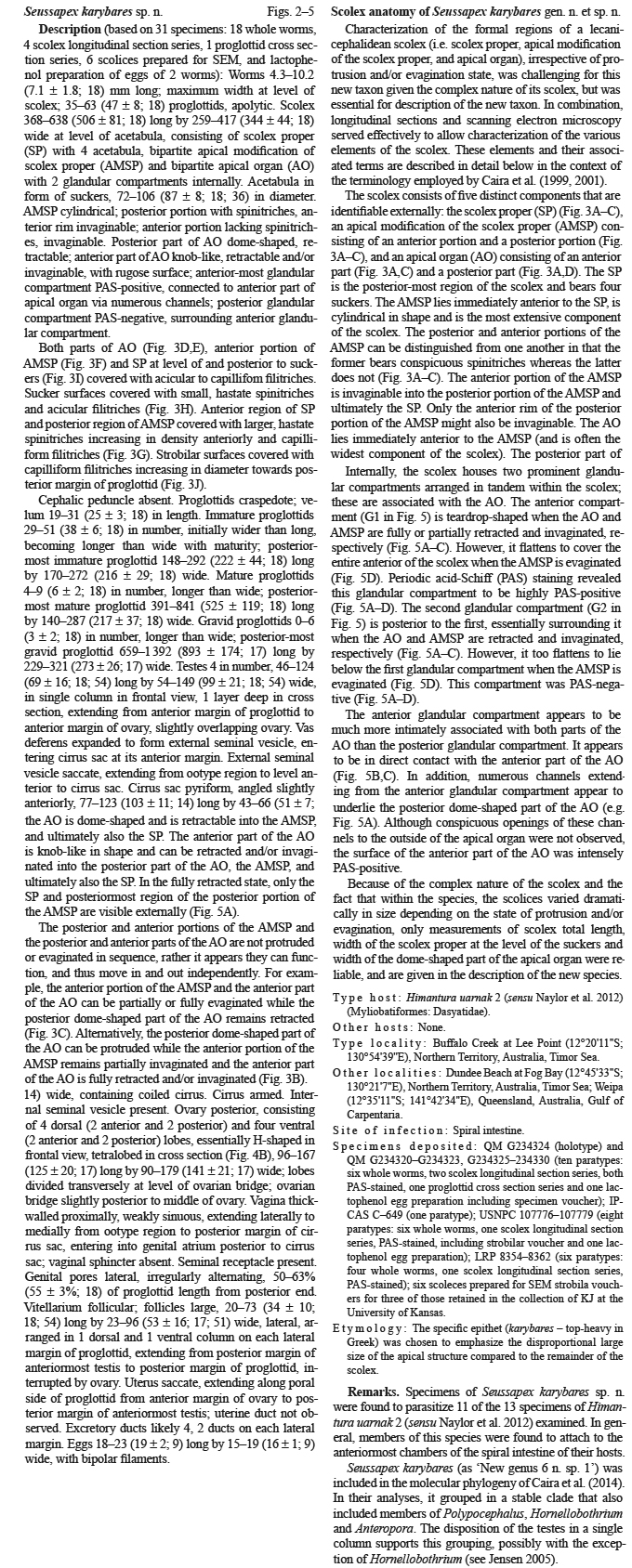
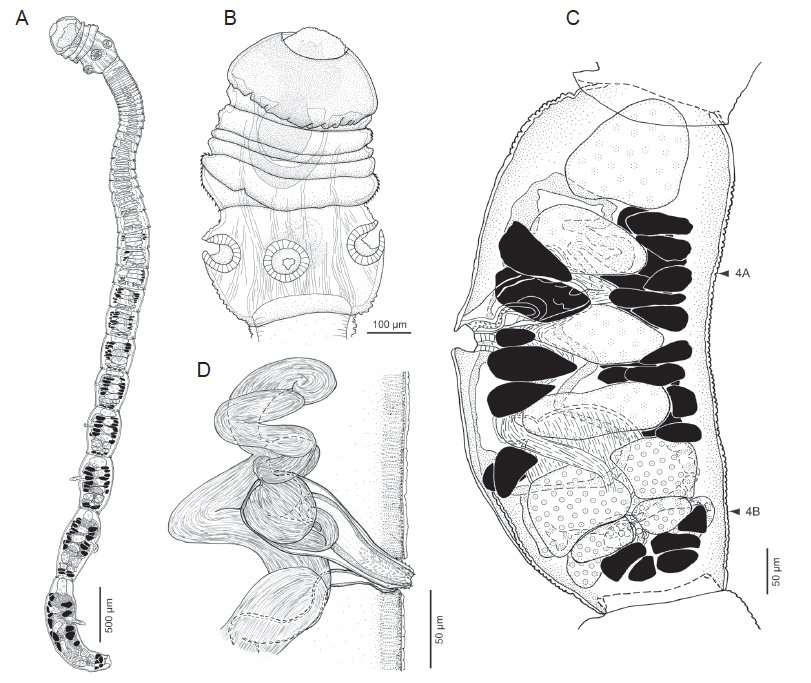 Fig. 2. Line drawings of Seussapex karybares gen. n. et sp. n. from Himantura uarnak 2 (sensu Naylor et al. 2012). A – whole worm;
scolex in fully protruded/evaginated state; B – scolex, in fully protruded/evaginated state; C – mature proglottid (subterminal) (arrowheads
indicate location of sections in Fig. 4A,B); D – detail of terminal genitalia.
Fig. 2. Line drawings of Seussapex karybares gen. n. et sp. n. from Himantura uarnak 2 (sensu Naylor et al. 2012). A – whole worm;
scolex in fully protruded/evaginated state; B – scolex, in fully protruded/evaginated state; C – mature proglottid (subterminal) (arrowheads
indicate location of sections in Fig. 4A,B); D – detail of terminal genitalia. 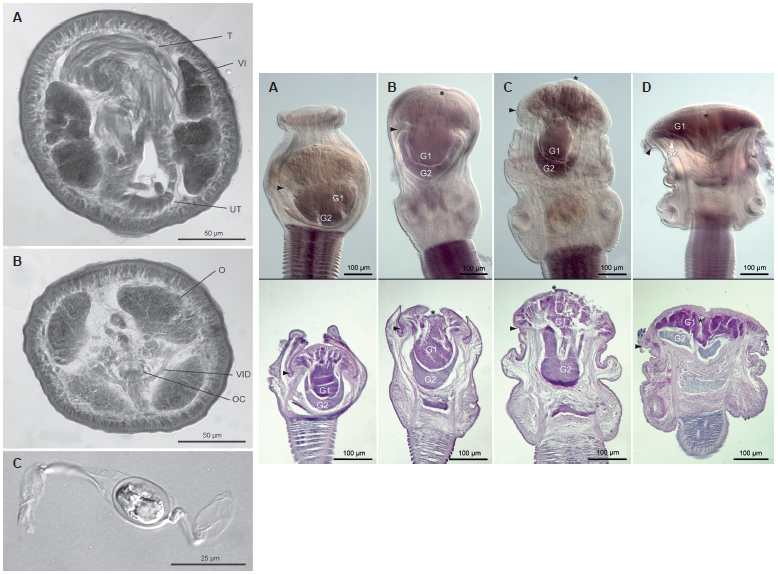 Photomicrographs of whole-mounted scoleces at different stages of protrusion/evagination (top row) and corresponding histological
longitudinal sections (PAS-stained) (bottom row) of Seussapex karybares gen. n. et sp. n. from Himantura uarnak 2 (sensu Naylor
et al. 2012). Black arrowheads indicate boundary AMSP and AO. A – scolex in fully retracted/invaginated state; anterior glandular
compartment of AO (G1) surrounded by posterior glandular compartment (G2), both retracted to level of scolex proper; B – scolex with
partially evaginated anterior portion of AMSP and partially protruded posterior dome-shaped part of AO (black star indicates retracted
anterior knob-like part of AO); G1 surrounded by G2, both retracted to essentially level of AMSP; C – scolex with partially evaginated
anterior portion of AMSP and fully protruded posterior dome-shaped part of AO (black star indicates protruded/evaginated anterior
knob-like part of AO); G1 covering almost entire anterior of scolex surrounded by G2; D – scolex with evaginated anterior portion of
AMSP and protruded posterior dome-shaped part of AO (black star indicates invagined anterior knob-like part of AO); G1 covering
entire anterior of scolex, lying above flattened G2.
Photomicrographs of whole-mounted scoleces at different stages of protrusion/evagination (top row) and corresponding histological
longitudinal sections (PAS-stained) (bottom row) of Seussapex karybares gen. n. et sp. n. from Himantura uarnak 2 (sensu Naylor
et al. 2012). Black arrowheads indicate boundary AMSP and AO. A – scolex in fully retracted/invaginated state; anterior glandular
compartment of AO (G1) surrounded by posterior glandular compartment (G2), both retracted to level of scolex proper; B – scolex with
partially evaginated anterior portion of AMSP and partially protruded posterior dome-shaped part of AO (black star indicates retracted
anterior knob-like part of AO); G1 surrounded by G2, both retracted to essentially level of AMSP; C – scolex with partially evaginated
anterior portion of AMSP and fully protruded posterior dome-shaped part of AO (black star indicates protruded/evaginated anterior
knob-like part of AO); G1 covering almost entire anterior of scolex surrounded by G2; D – scolex with evaginated anterior portion of
AMSP and protruded posterior dome-shaped part of AO (black star indicates invagined anterior knob-like part of AO); G1 covering
entire anterior of scolex, lying above flattened G2. 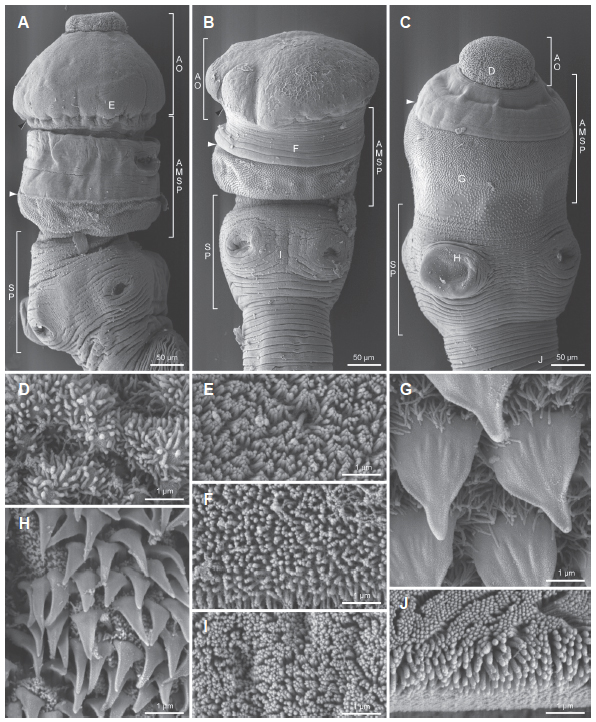 Scanning electron micrographs of Seussapex karybares gen. n. et sp. n. from Himantura uarnak 2 (sensu Naylor et al. 2012).
A – scolex in fully protruded/evaginated state showing scolex proper (SP) with suckers, posterior and anterior portion of apical modification
of scolex proper (AMSP), and posterior dome-shaped and anterior knob-like part of apical organ (AO); B – scolex in partially
protruded/evaginated state showing SP, posterior and anterior portion of AMSP, and posterior dome-shaped part of AO; anterior knoblike
part of AO retracted and/or invaginated into posterior part of AO; C – scolex in partially protruded/evaginated state showing SP,
posterior and anterior portion of AMSP, and anterior knob-like part of AO; posterior dome-shaped part of the AO retracted into AMSP;
D – acicular filitrich or microvilli on anterior knob-like part of AO; E – acicular to capilliform filitriches on posterior dome-shaped part
of AO; F – acicular to capilliform filitriches on anterior portion of AMSP; G – larger, hastate spinitriches and capilliform filitriches on
posterior portion of AMSP; H – small, hastate spinitriches and acicular filitriches on sucker; I – acicular filitriches on scolex proper at
level of suckers; J – capilliform filitriches on proglottid, increasing in length and diameter towards posterior margin of proglottid. Abbreviations:
AMSP – apical modification of scolex proper; AO – apical organ; SP – scolex proper. White arrowheads indicate boundary
between posterior and anterior portion of AMSP; black arrowheads indicate boundary between anterior portion of AMSP and posterior
part of AO. In A–C, small letters indicate location of details shown in the respective figure.
Scanning electron micrographs of Seussapex karybares gen. n. et sp. n. from Himantura uarnak 2 (sensu Naylor et al. 2012).
A – scolex in fully protruded/evaginated state showing scolex proper (SP) with suckers, posterior and anterior portion of apical modification
of scolex proper (AMSP), and posterior dome-shaped and anterior knob-like part of apical organ (AO); B – scolex in partially
protruded/evaginated state showing SP, posterior and anterior portion of AMSP, and posterior dome-shaped part of AO; anterior knoblike
part of AO retracted and/or invaginated into posterior part of AO; C – scolex in partially protruded/evaginated state showing SP,
posterior and anterior portion of AMSP, and anterior knob-like part of AO; posterior dome-shaped part of the AO retracted into AMSP;
D – acicular filitrich or microvilli on anterior knob-like part of AO; E – acicular to capilliform filitriches on posterior dome-shaped part
of AO; F – acicular to capilliform filitriches on anterior portion of AMSP; G – larger, hastate spinitriches and capilliform filitriches on
posterior portion of AMSP; H – small, hastate spinitriches and acicular filitriches on sucker; I – acicular filitriches on scolex proper at
level of suckers; J – capilliform filitriches on proglottid, increasing in length and diameter towards posterior margin of proglottid. Abbreviations:
AMSP – apical modification of scolex proper; AO – apical organ; SP – scolex proper. White arrowheads indicate boundary
between posterior and anterior portion of AMSP; black arrowheads indicate boundary between anterior portion of AMSP and posterior
part of AO. In A–C, small letters indicate location of details shown in the respective figure. Best viewed in Firefox