Global Cestode Database
Cestode Scientific Name
| Species ID | 12214 |
|---|---|
| Order | Trypanorhyncha |
| Family | Tentaculariidae |
| Subfamily | |
| Genus | Tetrarhynchus |
| Species | bisulcatus |
| Authority | (Linton, 1889) Linton, 1890 |
| Taxonomic Status | Synonym |
| Valid Name | Nybelinia bisulcata (Linton, 1889) Dollfus, 1942 |
| Synonyms | Rhynchobothrium bisulcatum Linton, 1889 |
| Genus Record | No |
| Type Species | No |
| Verified | Yes |
| Verified By | I. Beveridge |
| Citation(s) |
Linton, E. 1889. Notes on Entozoa of marine fishes of New England, with descriptions of several new species. United States Commision of Fish and Fisheries. Part XIV. Report of the Commissioner for 1886 14: 453-511. (266) Download PDFLinton, E. 1890. Notes on Entozoa of marine fishes of New England, with descriptions of several new species. Part II. United States Commision of Fish and Fisheries. Part XV. Report of the Commissioner for 1887 15: 718-899. (1011) Download PDF |
| Redescription |
Dollfus, R.-P. 1942. Études critiques sur les tétrarhynques du Muséum de Paris. Archives du Muséum National d‘Histoire Naturelle, 6. Série 19: 7-466. (170) Download PDF |
| Scientific Name Notes | Cited as Tetrarhynchus bisulcatum in Linton, 1897 |
Record Data
| Date (MM/DD/YYYY) | Action | User Name |
|---|---|---|
| 02/05/2013 | Created | B. Barbeau |
| 05/06/2015 | Modified | |
| 05/19/2015 | Modified | I. Beveridge |
| 06/19/2015 | Modified | I. Beveridge |
| 05/17/2016 | Modified | B. Barbeau |
| 05/26/2017 | Modified | K. Jensen |
| 12/22/2021 | Modified | B. Barbeau |
| 01/12/2022 | Modified | B. Barbeau |
Type Host
| Host Class | Elasmobranchii | ||||||
|---|---|---|---|---|---|---|---|
| Host Order | Carcharhiniformes | ||||||
| Host Family | Carcharhinidae | ||||||
|
Type Host (Literal) |
|
||||||
|
Type Host (Valid) |
|
||||||
| Additional Host(s) | Scolex encysted: in submucous coat of stomach and peritoneum of squeteague (Cynoscion regule) and bluefish (Pomatomus saltatrix) | ||||||
| Site in Host | pylorus and spiral intestine | ||||||
| Host Notes |
Type Locality
| Country | U.S.A. |
|---|---|
| Body of Water | Atlantic Ocean |
| Island(s) | |
| City/Region | Woods Hole, Massachusetts |
| Coordinates | |
| DD Latitude | |
| DD Longitude | |
| Additional Localities | |
| Locality Notes |
Specimens
| Type Material | |
|---|---|
| Total Number of Type Specimens | |
| Voucher Material | |
| Specimen Notes | At some point, USNPC 7724 was listed as the holotype for this species; however I (KJ 2017) do not think this is true since the USNM database gives Paralichthys dentatus as the host for that specimen. |
Data are given as in original description unless otherwise indicated.
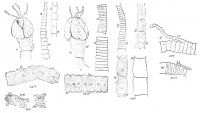
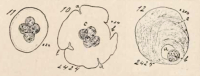
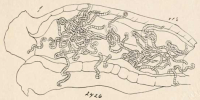
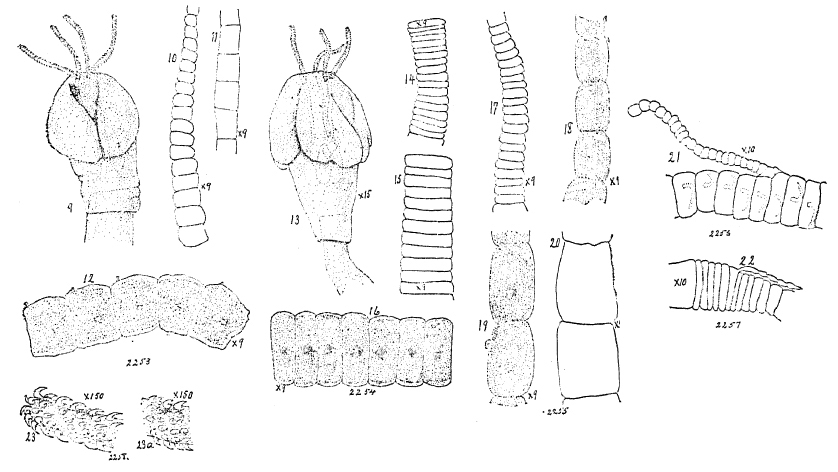 Plate IV. Figs. 9-23. Rhynchobothrium bisulcatum sp. nov. Head and neck, lateral view, var. a (see description), enlarged 15 diameters. Fig. 10. Anterior segments of same specimen, enlarged 9 diameters. Fig. 11. Antero-median segments of same, enlarged 9 diameters. Fig. 12. Posterior segments of same; length of strobile 48mm; enlarged 9 diameters. Fig. 13. Head and neck, marginal view, var. y (see description); length of strobile 92mm; enlarged 15 diameters. Fig. 14. Antero-median segments of same, enlarged 9 diameters. Fig. 15. Median segments of same, enlarged 9 diameters. Fig. 16. Posterior segments of same, enlarged 9 diameters. Fig. 17. Anterior segments of another specimen, var. B (see description); length of strobile 230mm; enlarged 9 diameters. Fig. 18. Median segments of same, enlarged 9 diameters. Fig. 19. Postero-median segments of same, enlarged 9 diameters. Fig. 20. Outline of posterior segments of same, enlarged 9 diameters. Fig. 21. Abnormal form, secondary chain of segments, originating from the margins of two primary segments, enlarged 10 diameters. Fig. 22. Another secondary chain from the postero-marginal border of a primary segment, enlarged 10 diameters. Fig. 23. Apex of proboscis, enlarged 150 diameters. Fig. 23a. Base of same, enlarged 150 diameters.
 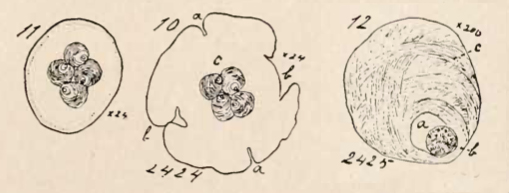 From Linton, 1890 (Cit# 1011). Plate XIV. Tetrarhynchus bisulcatum Lt. Fig. 10. Outline of section through base of bothria, X24; a, a, sulci separating the bothria of the lateral pairs from each other; b, b, marginal spaces separating the pairs of bothria; c, the four contractile bulbs of the proboscides; for an enlarged sketch of one of these sections see Fig. 12. Fig. 11. Outline of section through the tubular neck and contractile bulbs, X24. Fig. 12. Transverse section through a contractile bulb, X about 200: a, interior cavity which in life is filled with a fluid containing a few refractile granules, the function of the fluid, when compressed, being to evert the proboscis; b, section of retractor muscle; c, section of muscular wall of the bulb, showing the alternating layers of diagonal muscles. All the figures made by Margaret B. Linton.
 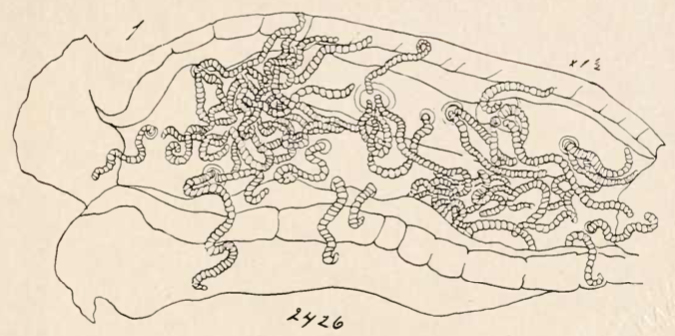 From Linton, 1890 (Cit# 1011). Plate XV. Tetrarhynchus bisulcatum Lt. Fig. 1. Portion of pyloric division of the stomach of Carcharias obscurus with the parasites attached to the mucous membrane. In some cases two or more scolices are buried in a common pit, X 1 1/2.
  From Linton, 1890 (Cit# 1011)
 Best viewed in Firefox