Global Cestode Database
Cestode Scientific Name
| Species ID | 103 |
|---|---|
| Order | Caryophyllidea |
| Family | Lytocestidae |
| Subfamily | |
| Genus | Djombangia |
| Species | penetrans |
| Authority | Bovien, 1926 |
| Taxonomic Status | Valid |
| Valid Name | |
| Synonyms | Djombangia indica Satpute and Agarwal, 1974; Djombangia caballeroi Sahay and Sahay, 1977; Djombangia clariae Kundu, Bhattacharya and Datta, 1985. |
| Genus Record | No |
| Type Species | Yes |
| Verified | Yes |
| Verified By | T. Scholz |
| Citation(s) |
Bovien, P. 1926. Caryophyllaeidae from Java. Videnskabelige Meddelelser fra Dansk naturhistorisk Forening i Kobenhavn 82: 157-181. (654) Download PDF |
| Redescription |
Ash A., T. Scholz, M. Oros, and P. K. Kar. 2011. Tapeworms (Cestoda: Caryophyllidea), parasites of Clarias batrachus (Pisces: Siluriformes) in the Indomalayan Region. Journal of Parasitology 97(3): 435-459. (5944) Download PDF |
| Scientific Name Notes |
Record Data
| Date (MM/DD/YYYY) | Action | User Name |
|---|---|---|
| 10/13/2005 | Created | Scholz, A. Ash, Hanzelova |
| 07/22/2014 | Modified | |
| 10/14/2015 | Modified | N. Arisco |
| 10/03/2016 | Modified | B. Barbeau |
| 04/03/2020 | Modified | T. Scholz |
Type Host
| Host Class | |||||||
|---|---|---|---|---|---|---|---|
| Host Order | Siluriformes | ||||||
| Host Family | Clariidae | ||||||
|
Type Host (Literal) |
|
||||||
|
Type Host (Valid) |
|
||||||
| Additional Host(s) | Heteropneustes fossilis | ||||||
| Site in Host | duodenum | ||||||
| Host Notes |
Type Locality
| Country | East Java |
|---|---|
| Body of Water | River Brantas |
| Island(s) | |
| City/Region | near Djombang |
| Coordinates | |
| DD Latitude | |
| DD Longitude | |
| Additional Localities | Bangladesh; India (Assam, Bihar, Chhattisgarh, Maharashtra, West Bengal) |
| Locality Notes |
Specimens
| Type Material | Syntypes 4 slides - MHNG INVE 36035 |
|---|---|
| Total Number of Type Specimens | |
| Voucher Material | |
| Specimen Notes |
Data are given as in original description unless otherwise indicated.
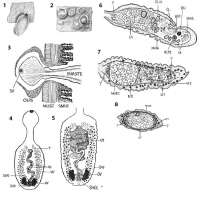
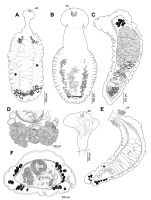
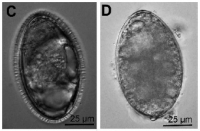
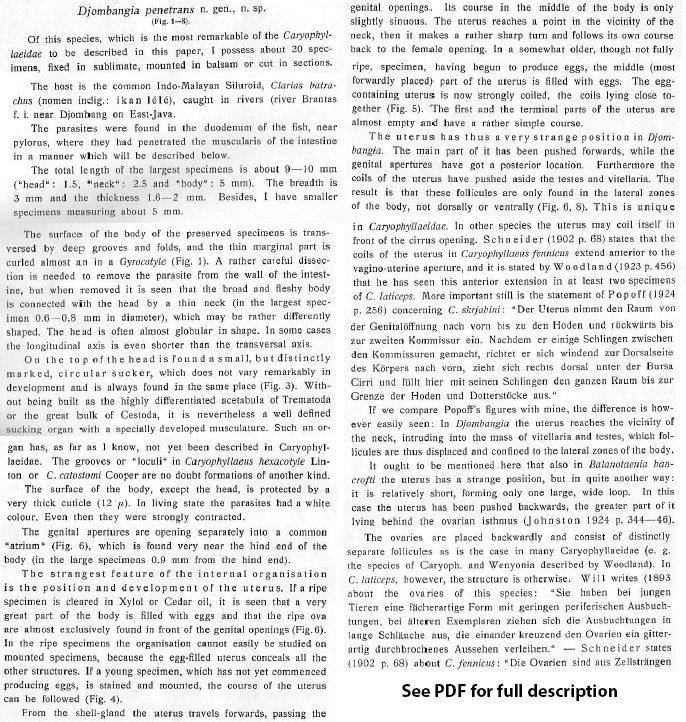
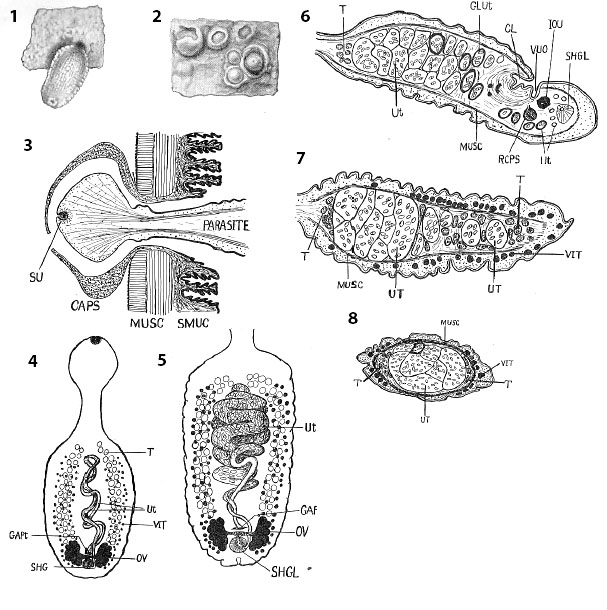 Fig. 1. Djombangia penetrans with head inserted in the intestinal wall of Ciarias. X 4. Fig. 2. Heads of Djombangia penetrans projecting from the outer surface of the intestine of Ciarias. The surrounding capsules are seen. X 4. Fig. 3. Section through the intestinal wall of Ciarias with head of Djombangia penetrans. The surrounding Capsule (CAPS) is seen. SU, sueker. MUSC, muscularis. SMUC, submucosa. Ca 15/1. Fig. 4. Structure of young specimen of Djombangia (Pressed). Ca. 15/1. -- Fig. 5. Specimen of Djombangia, which has begun to produce eggs. The head is ommitted. The course of the vaginary duct is not indicated. Ca 15/1. Fig. 6. Djombangia penetrans. Longitudinal section passing through genital openings. The head is omitted. Ca. 18/1. Fig. 7. Djombangia penetrans. Longitudinal section of lateral part of body. Ca 18/1. Fig. 8. Djombangia penetrans. Transverse section of body in front of the genital openings. Ca 15/1.
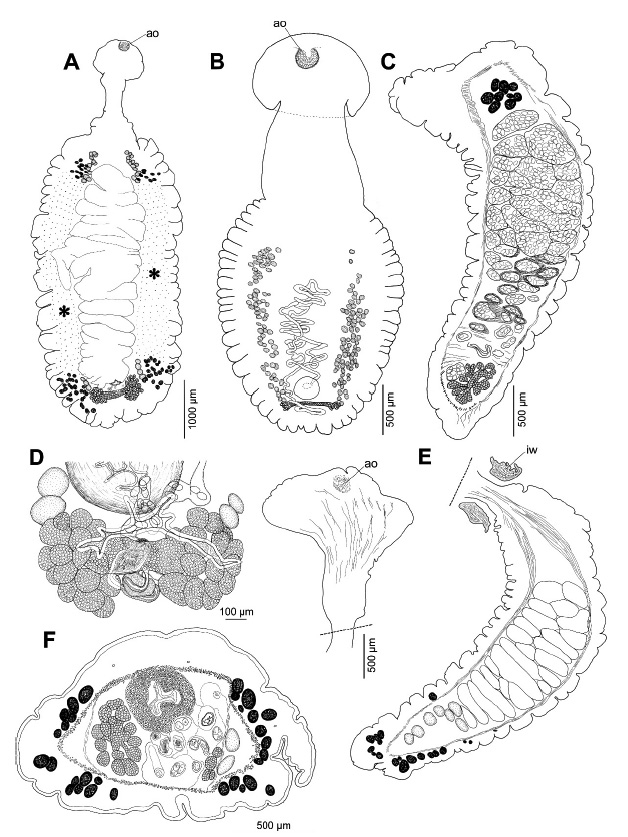 Figure 7. Djombangia penetrans Bovien, 1926. (A) Total view with the anterior- and posteriormost testes and vitelline follicles (* = not illustrated in between), ventral view; note an apical organ. (B) Total view of immature specimen with vitelline follicles not yet developed, dorsally; note an apical organ. (C) Sagittal section of the syntype (MHNG INVE 36035) at the level of the uterus; scolex not present. (D) Ovarian region, ventral view; note a well-developed seminal receptacle dorsal to the ovarian isthmus and a large, slit-like opening of the common genital atrium. (E) Sagittal section of the syntype (MHNG INVE 36035) at the level of posterior testes; note cortical vitelline follicles, the scolex penetrating throughout the intestinal wall of the host, and a glandular apical organ. (F) Cross-section at the level of the ovary; note the presence of vitelline follicles at the level of ovarian arms. Abbreviations: ao = apical organ; iw = intenstinal wall of the host.
 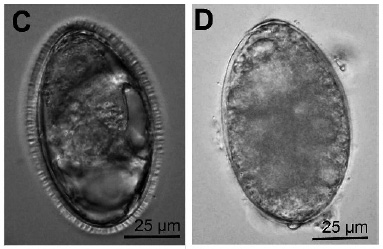 Figure 11. Photomicrographs of eggs. (C) Djombangia penetrans; note ripe egg covered with thick coat of short filaments. (D) D. penetrans; note unripe egg with smooth surface.
 Best viewed in Firefox